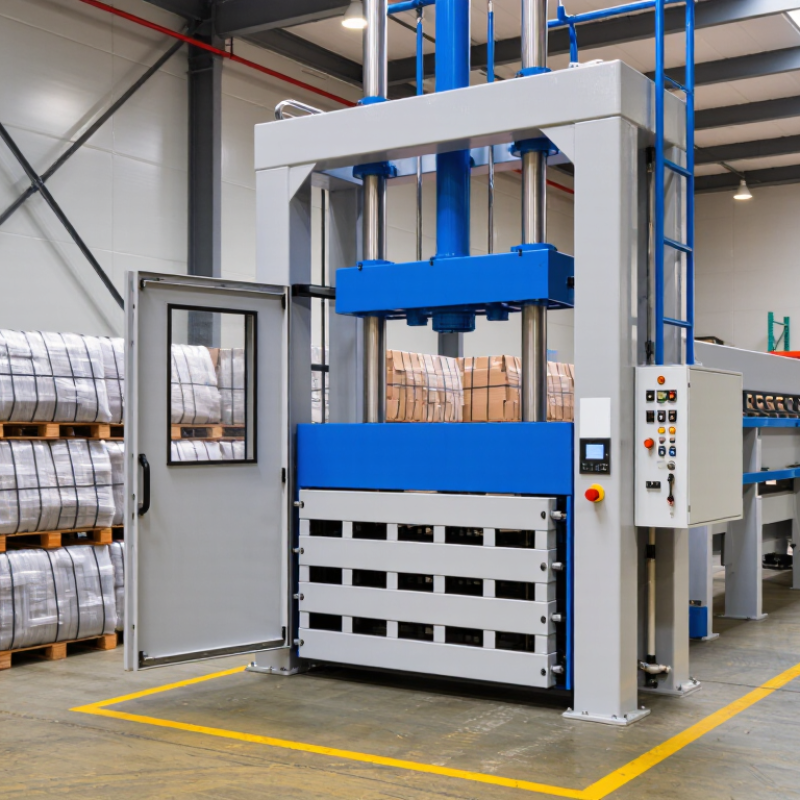
| Vertical Baler | Cardboard, paper, textile offcuts, soft plastic film | Mostly dry, manually fed, low to moderate contamination | 20–250 kg/h | 400 × 600 × 300–1,100 mm | 80–180 kg/m³ | Retail stores, offices, small warehouses, hotels | Low footprint, manual loading, cycle time, bale ejection method, electrical requirements |
| Small Horizontal Baler | Corrugated cardboard, mixed paper, PET bottles, aluminum cans | Pre-sorted material with continuous or batch feeding | 100–600 kg/h | 700 × 700 × 500–1,200 mm | 100–250 kg/m³ | Supermarkets, distribution centers, small material recovery facilities | Conveyor compatibility, automatic tying options, hopper size, safety interlocks |
| Two-Ram Baler | Cardboard, mixed paper, OCC, plastic containers, textiles | High-volume, variable-density material with moderate contamination | 1,000–5,000 kg/h | 1,100 × 750 × 750–1,500 mm | 350–650 kg/m³ | Large recycling facilities and transfer stations | High compaction force, automatic wire or strap tying, continuous-feed design, service access |
| Closed-Door Horizontal Baler | OCC, newspapers, office paper, PET and HDPE containers | Pre-sorted, relatively dry material requiring dense, uniform bales | 500–2,500 kg/h | 800 × 1,100 × 600–1,200 mm | 250–550 kg/m³ | Medium-scale recycling plants and paper stockrooms | Door locking system, bale ejection, tying configuration, chamber dimensions, ram pressure |
| Open-End Auto-Tie Baler | OCC, mixed paper, PET bottles, aluminum cans and selected plastics | Continuous-feed, sorted or semi-sorted streams | 2,000–8,000 kg/h | 1,100 × 1,100 × 750–1,500 mm | 350–700 kg/m³ | High-throughput material recovery facilities | Automatic tying speed, PLC controls, conveyor integration, bale stability, wire consumption |
| Plastic Film Baler | LDPE stretch film, agricultural film, shrink wrap and plastic bags | Lightweight, flexible material; should be reasonably dry and free of heavy debris | 100–1,200 kg/h | 700 × 700 × 500–1,200 mm | 150–350 kg/m³ | Distribution centers, supermarkets and plastics sorting lines | Anti-bridging hopper, film retention, tie strength, shredder or perforator compatibility |
| PET Bottle Baler | PET beverage bottles and similar rigid plastic containers | Sorted bottles; loose caps and labels may remain depending on recycling process | 500–3,000 kg/h | 1,100 × 750 × 750–1,200 mm | 200–400 kg/m³ | Bottle collection centers and plastics recovery facilities | Pre-crushing or perforation needs, bale integrity, moisture drainage, contamination tolerance |
| Metal Scrap Baler | Aluminum cans, light-gauge sheet metal, steel cans and non-ferrous scrap | Dry or lightly contaminated metal scrap; oversized pieces require pre-cutting | 500–4,000 kg/h | 300 × 300 × 200–600 mm | 500–1,200 kg/m³ | Scrap yards, can processing lines and metal recovery plants | Press force, wear-resistant chamber, shear protection, feed opening and hydraulic cooling |
| Textile Baler | Used clothing, household textiles, fabric scraps and nonwoven materials | Dry, flexible and relatively clean material; sorting improves bale value | 200–1,500 kg/h | 700 × 700 × 500–1,200 mm | 250–500 kg/m³ | Donation centers, textile sorting facilities and fiber recovery plants | Gentle compression, adjustable pressure, tying method, dust control and fire protection |
| Agricultural Fiber Baler | Straw, hay, cotton stalks, corn residues and selected biomass fibers | Pre-dried fibrous material; moisture control is essential for storage | 500–3,000 kg/h | 700 × 700 × 400–1,200 mm | 100–250 kg/m³ | Farm cooperatives, biomass collection sites and fiber processors | Material moisture, dust extraction, fire prevention, twine or wire tying and storage requirements |