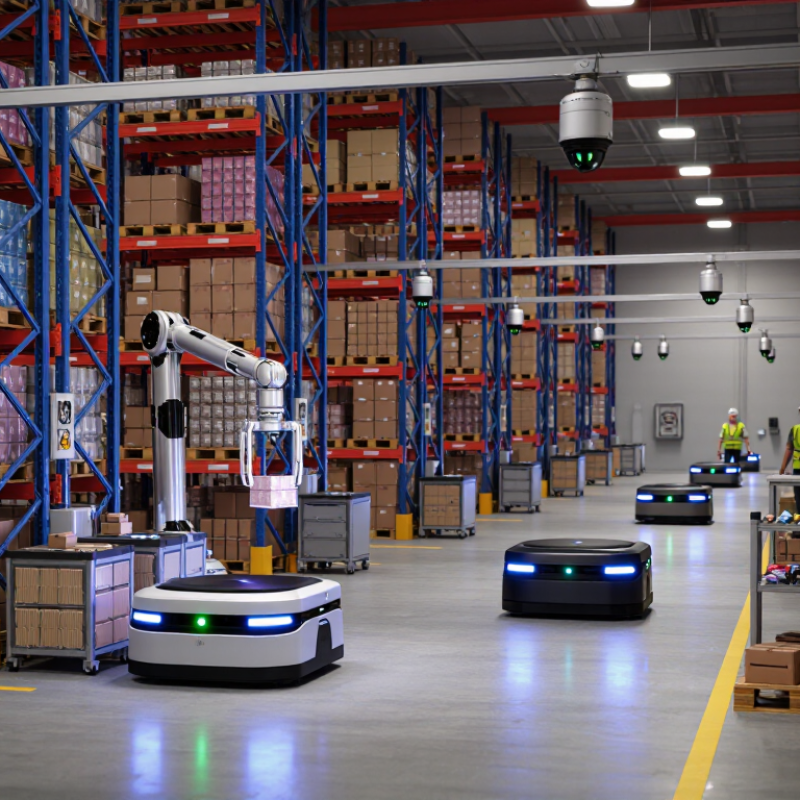
| Autonomous Mobile Robots for Goods-to-Person Picking | Piece picking from mobile inventory racks in e-commerce, retail replenishment, and spare-parts operations. | 300–1,500 kg per robot, depending on the carrier and rack configuration. | 80–250 tote or shelf moves per hour per robot; actual output depends on walking distance, workstation design, and SKU profile. | Mostly existing flat floors; wireless coverage, charging areas, rack-compatible floor locations, and protected pedestrian crossings. | REST or web-service APIs, warehouse-management-system task exchange, inventory synchronization, barcode or vision events, and fleet-management dashboards. | Verify local spare-parts stock, remote diagnostics, response-time commitments, technician coverage, battery replacement process, and operator training. | Robot fleet expansion without major building work; modular workstations; software support for multi-site control and workload balancing. |
| Autonomous Case-Handling Mobile Robots | Transporting cartons, cases, and pallets between storage, picking, packing, and shipping zones. | 500–2,000 kg per unit, subject to load-center and floor conditions. | 30–120 completed transport missions per hour per robot, influenced by travel distance and traffic density. | Marked traffic routes, floor-load verification, safety scanners, docking points, charging strategy, and controlled interaction with forklifts. | WMS and warehouse-control-system integration, mission queues, digital map management, equipment-status data, and optional PLC or conveyor handshakes. | Check safety validation documents, incident-reporting procedures, on-site commissioning resources, software-update policy, and escalation contacts by region. | Additional robots can be added progressively; traffic-management software should support priority rules, congestion control, and zone restrictions. |
| Robotic Picking Arms with Machine Vision | High-volume piece picking of reasonably standardized items from bins, totes, or conveyor presentations. | 0.1–15 kg typical item weight; gripper selection is critical for flexible packaging, reflective surfaces, and irregular products. | 600–1,200 picks per hour per cell in suitable item mixes; mixed-SKU performance can be materially lower. | Rigid mounting, guarded work cells, calibrated cameras, controlled lighting, compressed air where required, and stable product presentation. | PLC or industrial Ethernet communication, WCS/WMS order release, vision-event feedback, pick-confirmation data, and exception handling. | Validate achieved pick rates using the buyer’s SKU sample; review gripper-change time, vision-training responsibility, preventive maintenance, and safety certification. | Scale by adding cells, grippers, or parallel conveyors; confirm that software licensing and technical support remain practical at multiple sites. |
| Robotic Piece-Picking Workstations | Automated picking and placing between source totes and order containers in fulfillment and returns operations. | Up to approximately 10 kg per item in common configurations, with lower limits for delicate or deformable products. | 400–1,000 picks per hour per workstation, depending on SKU dimensions, presentation quality, and exception rate. | Ergonomic infeed and outfeed zones, safety guarding, tote standards, vision calibration, and adequate lighting. | Order-wave or task-based interfaces, barcode validation, inventory events, pick-confirmation messages, and operational-performance reporting. | Require a documented acceptance test, accuracy target, exception workflow, spare-camera and gripper availability, and local field-service arrangements. | Workstations can be deployed in parallel; assess software support for new SKUs, product master-data changes, and seasonal volume peaks. |
| Shuttle-Based Automated Storage and Retrieval Systems | Dense tote or carton storage with automated presentation to picking stations in high-throughput distribution centers. | Typically 30–50 kg per tote or carton; heavier-load versions require specific rack, shuttle, and lift designs. | Hundreds to several thousand tote movements per hour per system, depending on aisle count, lift capacity, and station configuration. | Engineered rack structure, controlled floor flatness, lifts, conveyors, fire-protection coordination, electrical capacity, and defined maintenance access. | WMS/WCS middleware, equipment-control interfaces, inventory location messages, conveyor PLC signals, and real-time fault notifications. | Check structural calculations, seismic design where applicable, local certification, mean-time-to-repair targets, critical spares, and disaster-recovery procedures. | Capacity grows through additional aisles, shuttles, lifts, and stations; verify that the control architecture supports phased expansion. |
| Vertical Lift Modules and Carousel-Based Picking | Small-item storage, high-value inventory, maintenance parts, and operations with limited floor space or high SKU density. | Common tray loads of 100–500 kg, subject to machine design and tray spacing. | 20–80 tray presentations per hour per module; operator travel and transaction method affect final output. | Level floor, overhead clearance, electrical supply, safe access, fire and building-code review, and operator-facing interfaces. | Inventory-control software, host-system APIs, barcode or RFID events, user authentication, and stock-audit reporting. | Confirm local installation capability, emergency retrieval procedures, service-part lead times, annual inspection requirements, and training materials. | Modules can be added by zone; expansion depends on ceiling height, floor loading, electrical capacity, and available operator stations. |
| Goods-to-Person Tote and Carton Systems | Fast order assembly where totes or cartons are automatically delivered to fixed picking and packing operators. | Typically 10–50 kg per container; container geometry and load distribution must be standardized. | 150–600 container presentations per hour per station, depending on ergonomics, batching, and replenishment logic. | Conveyor or robotic transport, standardized containers, buffer capacity, workstation ergonomics, network coverage, and power redundancy. | WMS/WCS integration, order batching, inventory allocation, container tracking, packing confirmation, and system-performance dashboards. | Review service-level agreements, 24/7 support availability, remote-access controls, cybersecurity responsibilities, and recovery procedures after equipment downtime. | Scale through additional stations, buffers, and transport capacity; model peak-season throughput rather than average daily volume. |
| Autonomous Forklift and Pallet-Movement Robots | Pallet transport, put-away, replenishment, and staging in structured storage and manufacturing logistics environments. | Common ratings of 1,000–2,500 kg; rack height, pallet condition, and load stability determine usable capacity. | 10–40 pallet moves per hour per vehicle, depending on route length, rack height, and traffic controls. | Validated floor condition, rack-location mapping, pallet standards, safety zones, charging areas, and coexistence rules for manual vehicles. | WMS task assignment, warehouse-control integration, fleet traffic management, PLC or door signals, and pallet identification events. | Verify compliance with applicable mobile-robot and industrial-truck safety requirements, site risk assessment, operator training, and emergency support. | Fleet size can increase incrementally; confirm that charging, traffic management, and narrow-aisle performance remain stable at peak utilization. |
| Hybrid Robotic Picking Cells | Mixed automation environments combining mobile transport, robotic picking, conveyors, and human exception handling. | Varies by subsystem: approximately 0.1–15 kg for robotic picks and up to 1,500 kg for mobile transport loads. | System-level output is application-specific; a practical design review should measure picks, replenishment, exceptions, and packing capacity together. | Coordinated layout, safety zoning, shared data network, standardized containers, exception benches, and integrated maintenance access. | Unified orchestration layer, WMS/WCS interfaces, robot-fleet APIs, machine telemetry, barcode or vision data, and common event logging. | Assess the supplier’s responsibility matrix, multi-vendor integration experience, cybersecurity controls, change-management process, and escalation ownership. | Strongest option for staged growth when interfaces are open; require documented limits for concurrent robots, stations, sites, and software tenants. |