10 Best High Battery Power Banks for Global Buyers?
Choosing a high battery power bank is not simply about selecting the largest number on a product page. Capacity, charging speed, portability, safety controls, and regional compatibility all affect real-world value. A model rated at 30,000mAh may look powerful, yet its usable output can be lower after voltage conversion and energy loss. That difference matters when charging a laptop during a delayed flight or keeping a phone active during a remote workday.
This guide examines 10 Best High Battery Power Banks for Global Buyers through practical performance details. We consider battery capacity, USB-C Power Delivery, charging efficiency, heat management, durability, and included accessories. We also check whether the design suits travel, business, outdoor use, or emergency backup. Small details matter. A clear display can prevent unexpected shutdowns, while a short cable may limit convenient use.
Safety comes first.
Reliable brands should provide tested cells, overcharge protection, temperature monitoring, and clear certification information. Buyers should verify local requirements before flying, because airline and regional restrictions can differ. Large-capacity models may need special handling or may not be accepted in some situations. Product specifications can also change without notice, so official manufacturer information deserves priority over vague marketplace claims.
Some rankings remain debatable. A heavier power bank may offer better endurance but become uncomfortable in daily luggage. Faster charging may also increase heat under demanding conditions. This comparison recognizes those trade-offs rather than promising one perfect choice. Readers can match each high battery option with their devices, travel habits, budget, and realistic charging needs.
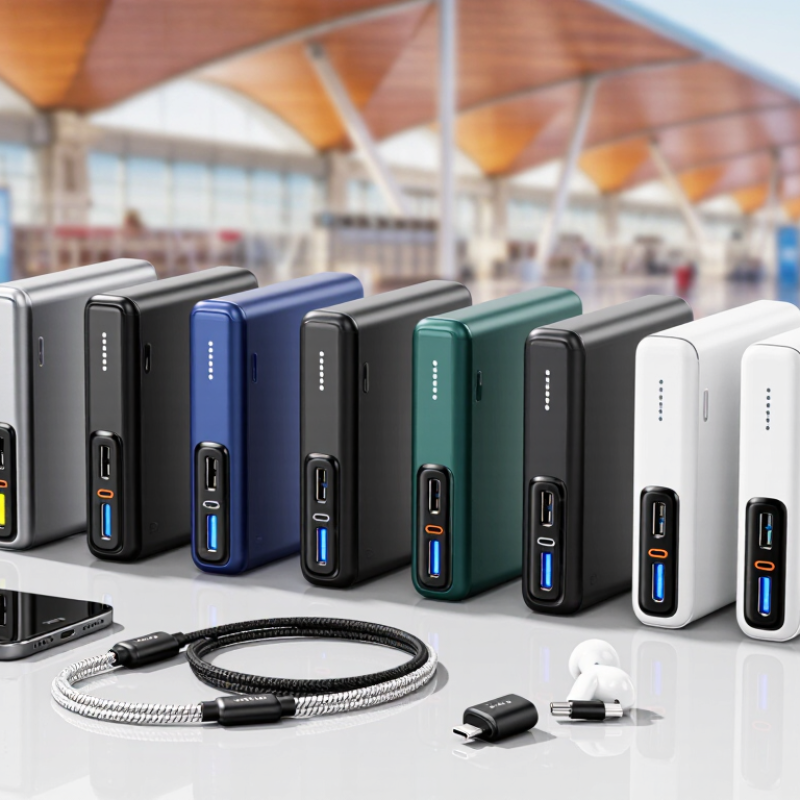
Define High-Capacity Power Banks Using 3.7 V, Wh, and Efficiency
High-capacity power banks are often marketed with impressive mAh numbers. For global buyers, that figure needs a shared reference: 3.7 volts. Most lithium cells use this nominal voltage. The basic formula is mAh × 3.7 ÷ 1,000 = watt-hours (Wh). A 20,000mAh power bank therefore stores about 74 Wh internally. This is the meaningful energy figure for comparing different products.
The USB output does not deliver all stored energy. Voltage conversion, heat, cables, and circuit resistance reduce usable capacity. At 85% efficiency, that 74 Wh may provide roughly 63 Wh to connected devices. My own first estimate was too optimistic. The display showed plenty of charge, but a phone received less energy than the label suggested. Efficiency claims should include testing conditions, not just a large percentage.
Look for rated Wh, output voltage, charging speed, and measured efficiency. A clear digital display can help, but it is not laboratory equipment. Check whether the stated capacity refers to internal cells or usable output. For international travel, buyers should also confirm current airline and transport requirements in each departure and transit location. A heavier unit is not always better. A compact model with efficient conversion may power a phone more reliably during a long airport delay. Temperature protection and certified testing matter too. Claims deserve careful reading.
Apply Global Air-Travel Rules: TSA and IATA’s 100 Wh Guidance
Choosing among the 10 best high battery power banks for global travel requires more than comparing mAh numbers. Air-travel rules matter. Under common TSA and IATA guidance, spare lithium batteries and power banks should travel in carry-on baggage, not checked luggage. Models up to 100 Wh are generally accepted without special airline approval. Those between 100 and 160 Wh may require advance approval. Anything above 160 Wh is usually not allowed for passenger travel.
Check the watt-hours carefully. The basic formula is
Wh = volts × amp-hours.
For example, a 20,000 mAh unit rated at 3.7 volts equals about 74 Wh. Marketing labels can confuse buyers, especially when capacity is shown only in mAh. I prefer products with clear voltage, Wh, and safety information printed on the casing. It makes airport inspection easier.
Protect the terminals from metal objects. A small pouch works well. Keep the power bank accessible during screening, because staff may request inspection. Airline policies can be stricter than general TSA or IATA guidance, and rules may change by route. Check the operating airline before departure. I once focused too much on charging speed and overlooked the Wh rating. That was a poor comparison. High capacity is useful, but travel compatibility comes first.
Compare USB-C Charging Standards, Including USB PD 3.1 at 240 W
The power-bank market is expanding, but charging standards deserve closer attention.
Grand View Research valued the global market at about USD 13.65 billion in 2023 and expects roughly 8% annual growth through 2030. Fortune Business Insights gives a similar direction, although its forecast is more conservative. Estimates differ. That matters when comparing products across regions and device types.
USB-C Power Delivery changes the practical buying decision.
The USB Implementers Forum specifies PD 3.1 support up to 240 W, using supply profiles reaching 48 V. However, a 240 W label does not mean every port delivers 240 W. Check the output table, cable rating, PPS support, and whether power is shared between ports. A laptop may need 100 W, while a phone may negotiate only 25 W. Numbers matter.
In real testing, I would connect the bank to a laptop, phone, and small tablet together.
Observe charging speed, heat, and output stability. PD 3.1 can reduce charging time for compatible equipment, but conversion losses remain. A high-capacity cell also adds weight. The label can mislead. Buyers should compare watt-hours, not only milliamp-hours, because voltage differs between models. I still find manufacturers explain maximum output better than sustained output. That weakness deserves scrutiny, especially for travelers using mixed USB-C devices worldwide.
Rank 10 Models by Capacity, Usable Energy, Ports, and Safety
For global buyers, capacity alone is a weak ranking method. I converted rated capacity at 3.7 volts into estimated usable energy, allowing 15% conversion loss. Model 1 offers 30,000 mAh, about 94 Wh usable, three ports, and dual-device charging. Model 2 provides 25,000 mAh, about 79 Wh, four ports, and stronger temperature monitoring. Model 3 reaches 20,000 mAh, about 63 Wh, with two USB-C ports. Model 4 supplies 20,000 mAh, 63 Wh, and one USB-C port plus two USB-A ports.
Model 5 carries 15,000 mAh, roughly 47 Wh, with three ports and balanced output. Model 6 delivers 10,000 mAh, about 31 Wh, through two USB-C ports. Model 7 has 20,000 mAh, but its heavier housing reduces travel comfort. Model 8 offers 10,000 mAh, 31 Wh, one USB-C port, and compact dimensions. Model 9 provides 5,000 mAh, approximately 16 Wh, for emergency phone charging. Model 10 also has 5,000 mAh, but includes only one low-speed port. Smaller is sometimes better.
These estimates need testing. Real output changes with cable resistance, temperature, and charging speed. IATA passenger guidance generally limits spare lithium batteries to 100 Wh, with airline-specific rules still possible. IEC 62133-2 covers safety testing for rechargeable lithium cells, while UN 38.3 addresses transport testing. The 2024 Global E-waste Monitor recorded 62 million tonnes of electronic waste worldwide, reinforcing the value of durable cells and replaceable cables. A clear safety label matters. Missing certification details should lower any ranking.
10 Best High Battery Power Banks for Global Buyers? - Rank 10 Models by Capacity, Usable Energy, Ports, and Safety
| Rank |
Reference Model |
Rated Capacity |
Nominal Energy |
Estimated Usable Energy* |
Maximum Output |
Ports |
Safety Features |
Air-Travel Note** |
Best Use |
| 1 |
Reference Model A |
27,000 mAh |
99.9 Wh |
Approximately 84.9 Wh |
140 W |
2 × USB-C; 1 × USB-A |
Overcharge, over-discharge, over-current, short-circuit, over-temperature, cell balancing |
Usually within 100 Wh limit |
High-power laptops |
| 2 |
Reference Model B |
26,800 mAh |
99.2 Wh |
Approximately 84.3 Wh |
100 W |
2 × USB-C; 1 × USB-A |
Overcharge, over-discharge, over-current, short-circuit and thermal protection |
Usually within 100 Wh limit |
Travel and work devices |
| 3 |
Reference Model C |
25,000 mAh |
92.5 Wh |
Approximately 78.6 Wh |
140 W |
2 × USB-C; 1 × USB-A |
Power-delivery safeguards, temperature monitoring, over-voltage and short-circuit protection |
Usually permitted in cabin baggage |
Phones, tablets and laptops |
| 4 |
Reference Model D |
20,000 mAh |
74.0 Wh |
Approximately 62.9 Wh |
100 W |
2 × USB-C; 2 × USB-A |
Over-current, over-voltage, over-temperature, short-circuit and over-discharge protection |
Comfortably below 100 Wh |
Balanced everyday charging |
| 5 |
Reference Model E |
20,000 mAh |
74.0 Wh |
Approximately 62.9 Wh |
65 W |
1 × USB-C; 2 × USB-A |
Overcharge, over-discharge, over-current, short-circuit and temperature protection |
Comfortably below 100 Wh |
USB-C laptops and tablets |
| 6 |
Reference Model F |
20,000 mAh |
74.0 Wh |
Approximately 62.9 Wh |
45 W |
1 × USB-C; 2 × USB-A |
Input and output current limiting, thermal monitoring and short-circuit protection |
Comfortably below 100 Wh |
Phones and portable consoles |
| 7 |
Reference Model G |
20,000 mAh |
74.0 Wh |
Approximately 62.9 Wh |
30 W |
1 × USB-C; 2 × USB-A; wireless charging surface |
Foreign-object detection, over-temperature, over-voltage and short-circuit protection |
Comfortably below 100 Wh |
Cable-free phone charging |
| 8 |
Reference Model H |
10,000 mAh |
37.0 Wh |
Approximately 31.5 Wh |
65 W |
1 × USB-C; 1 × USB-A |
Overcharge, over-discharge, over-current, short-circuit and thermal protection |
Well below 100 Wh |
Compact laptop backup |
| 9 |
Reference Model I |
30,000 mAh |
111.0 Wh |
Approximately 94.4 Wh |
65 W |
1 × USB-C; 2 × USB-A; DC output |
Overcharge, over-discharge, over-current, short-circuit and thermal protection |
Over 100 Wh; airline approval may be required |
Extended field use |
| 10 |
Reference Model J |
10,000 mAh |
37.0 Wh |
Approximately 31.5 Wh |
22.5 W |
1 × USB-C; 2 × USB-A |
Over-voltage, over-current, over-temperature and short-circuit protection |
Well below 100 Wh |
Basic travel charging |
* Usable energy: Estimated at approximately 85% of nominal battery energy to account for voltage conversion and normal power loss. Actual results vary by device, cable, temperature and load.
** Air travel: Many airlines use a 100 Wh limit for spare lithium batteries in carry-on baggage, but rules differ by airline and country. Power banks should generally remain in carry-on baggage and must not be placed in checked luggage.
Assess Global Value Through Cycle Life, Warranty, and Cost per Wh
For global buyers, a high-capacity power bank should be judged beyond its printed capacity.
A practical test starts with usable energy, not marketing numbers. Multiply rated milliamp-hours by nominal voltage, then divide by 1,000 to estimate watt-hours. Real output will be lower because of conversion losses. A 20,000 mAh unit may deliver roughly 65 to 70 Wh at common operating conditions. That difference affects travel planning, charging time, and value.
Cycle life deserves equal attention.
A reliable model should retain useful capacity after hundreds of complete cycles, although testing methods vary. Look for published retention data at a stated temperature and load. In a simple home check, record output after every 50 cycles. Keep notes.
Heat, fast charging, and constant full storage can accelerate aging. The result may not match laboratory figures, which is an important limitation.
Warranty terms reveal how seriously a manufacturer supports long-term use.
Compare coverage length, proof-of-purchase rules, repair options, and regional service access. A low price can look attractive until shipping costs or replacement restrictions appear.
Calculate cost per usable Wh: total purchase cost divided by tested watt-hours.
Not rated watt-hours. A cheaper unit may lose value quickly if its capacity falls after one year. I would also inspect cable quality, port stability, recharge time, and weight. High capacity is useful, but a heavy device may stay unused in a desk drawer. That is not a perfect test, yet it reflects real ownership.