
Choosing an Audio Intercom System For Apartments is not just about hearing a visitor’s voice. The right setup should help residents identify callers, communicate clearly, and manage entry without adding friction to daily routines. A quiet lobby, a noisy street, and a resident answering from an upstairs kitchen all place different demands on audio quality. Small details matter.
For transparency, the following is an illustrative quote from a fictional building-systems consultant, not a verified statement by a real expert: “Clear audio is useful only when residents can trust what they hear.” It captures a practical point. Echo, background noise, poor microphone placement, and confusing controls can weaken an otherwise capable system. A crisp speaker test in a showroom may not reflect a crowded apartment entrance.
This guide examines what apartment managers and property owners should compare when researching leading suppliers in China. It considers sound clarity, door-station design, resident usability, installation needs, and after-sales support. Supplier claims still deserve careful checking; a polished product page is not proof of dependable performance. Ask for demonstrations under realistic conditions, including conversations with the entrance door closed. No system is perfect, and requirements vary between buildings. The goal is a reliable fit—not the longest feature list.
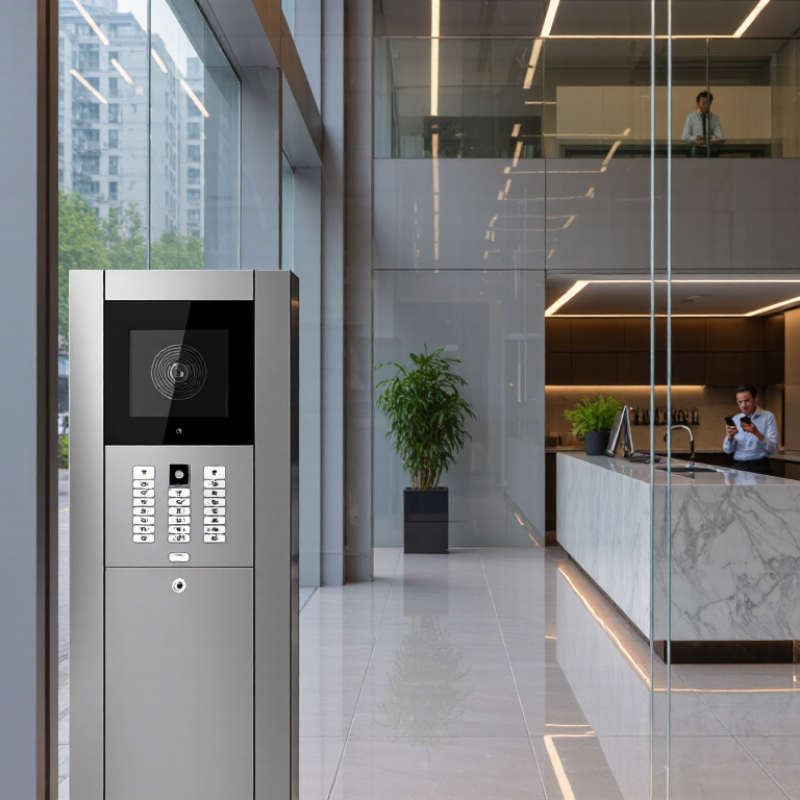
An audio intercom system for apartments lets residents speak with visitors at a shared entrance before granting access. A typical setup includes an outdoor panel with a microphone and speaker, indoor handsets or wall stations, and a control unit. When a visitor presses an apartment number, the resident’s station rings and opens a two-way voice connection.
Some systems also connect to an electric door release, allowing a resident to unlock the entrance remotely. The exact function depends on the building’s wiring and door hardware. In an older apartment block, for example, a technician may need to check existing cables before recommending a replacement. A clear voice connection matters. Residents should be able to hear a visitor over hallway noise and answer without searching for complicated controls.
Audio-only systems do not show who is calling. That limitation is easy to overlook. Sound quality can also suffer from loose connections, worn handsets, or a poorly positioned entrance panel. Regular checks help identify these problems before residents miss calls. Building managers should consider the number of apartments, wiring condition, and expected maintenance when comparing system options. A system can be simple and practical, but it is not a substitute for careful access procedures.
In a typical apartment audio intercom, a visitor presses a unit number on the entrance panel. The panel sends a call through building wiring or a network connection to the resident’s handset. A microphone and speaker carry the conversation in both directions. If the resident approves entry, pressing a button activates a relay that releases the door lock. Simple, but not foolproof. Poor wiring, background noise, or a faulty handset can make voices difficult to hear.
Systems vary. Older buildings often use shared copper wiring, while newer installations may use IP networks and centralized controllers. IP systems can simplify management across multiple entrances, but they depend on reliable network power and configuration. Grand View Research estimated the global access-control market at USD 10.14 billion in 2022 and projected an 8.1% compound annual growth rate from 2023 to 2030. That figure covers access control broadly, not apartment audio intercoms alone. For property teams, it signals wider investment in entry systems, but it does not prove every building needs a networked upgrade. Test call clarity at the lobby panel and upper floors before choosing equipment. Small details matter. A resident may hear a visitor clearly while the visitor hears only a faint echo.
Voice frequency ranges vary between speakers. The 300–3,400 Hz range is a commonly cited telephone speech band, illustrating the frequencies that can carry much of a conversation in an audio intercom system.
Apartment audio intercom systems usually fall into three groups: audio-only, video-enabled, and network-based systems. Audio-only units use an indoor handset or wall panel to speak with visitors and release the entrance door. They are often straightforward to operate, especially for residents who prefer a physical button. Simple, but limited.
Video intercoms add a camera and indoor display, helping residents check who is at the entrance before answering. Image quality, night visibility, and camera angle matter more than a long feature list. IP-based systems send calls through a building network and may support mobile answering, resident directories, and management tools. That convenience depends on stable network coverage and careful setup. A weak signal can spoil the experience.
Useful features include clear two-way audio, adjustable volume, door-release control, and backup power for outages. In multi-unit buildings, check whether the directory is easy to update and whether each apartment can be reached reliably. Installation details matter too: older wiring may not suit every system, and replacing it can add cost. One overlooked point is usability. A complicated menu may frustrate residents, even when the system offers more functions.
| System Type | Typical Architecture | Key Features | Advantages | Considerations | Common Apartment Applications |
|---|---|---|---|---|---|
| Analog 4+N System | Separate conductors are typically used for shared functions, with an additional call line for each apartment; exact wiring varies by design. | Audio communication between the entrance panel and apartment handsets; door-release control is commonly supported. | Simple system architecture and familiar operation; can suit smaller buildings with straightforward call requirements. | Requires more apartment-specific wiring than many bus-based designs. Adding apartments or functions can involve additional cabling and installation work. | Small apartment buildings and projects where existing compatible wiring can be reused. |
| 2-Wire Bus System | Indoor stations and entrance equipment communicate over a shared two-conductor bus; power and signaling arrangements depend on the system design. | Apartment calling, two-way audio, door release, and support for multiple stations or entrances in configurations designed for those functions. | Can reduce cabling compared with traditional multi-wire layouts and may simplify installation in new builds or suitable renovations. | Devices must be compatible with the selected system. Cable distance, topology, and the number of devices should be checked against the system specifications. | Low- to mid-rise apartments, renovations, and buildings seeking simpler cabling. |
| IP / SIP Audio System | Network-connected door stations and indoor endpoints communicate over an IP network; SIP-based systems can use standard VoIP signaling. | Two-way audio, network-based call routing, centralized configuration, and potential integration with compatible PBX or building-management systems. | Can support distributed buildings and centralized administration. Network infrastructure may make expansion and system management more flexible. | Requires suitable network design, power provision, cybersecurity controls, and configuration. Compatibility with existing telephony or network equipment should be verified. | Large or multi-building apartment properties and projects with existing managed network infrastructure. |
| Wireless Audio Intercom | Uses a wireless link between some system components; the entrance unit and indoor endpoints may still require local power or wired connections. | Audio calling and door-release functions where supported by the selected equipment; installation methods vary by wireless technology. | May reduce the need to run signal cable in locations where cabling is difficult or disruptive. | Coverage, interference, building materials, power availability, and local radio requirements need assessment. Wireless does not necessarily mean cable-free installation. | Retrofits or limited areas where new signal cabling is impractical and wireless coverage can be validated. |
| Hybrid System | Combines wired apartment connections with network, bus, or wireless links between selected system components. | Can connect legacy wiring or equipment with newer entrance, management, or communications components, subject to interface compatibility. | Offers a staged upgrade path when a complete replacement is not practical. | System design and integration require careful compatibility checks; troubleshooting may involve more than one communications technology. | Existing apartment buildings upgrading in phases or combining older wiring with newer infrastructure. |
China’s National Bureau of Statistics reported that 67.00% of the population lived in urban areas in 2024. Its Statistical Communiqué on 2024 National Economic and Social Development offers useful housing context, but it does not measure intercom demand.
Evaluate suppliers against your actual building: ask for clear audio tests, supported wiring options, and compatibility records for existing door controllers. A sample call from a noisy lobby can reveal more than a polished brochure.
Check factory quality records, component traceability, firmware update procedures, and warranty response times. Request references for projects with similar building heights and entrance layouts. Ask the supplier to document SIP or other communication protocols, data handling, and the process for fixing faults.
Test it on site. A written service plan matters, too. One weakness in many evaluations: buyers compare unit prices but overlook replacement lead times and the cost of site visits.
Tips: Use a small pilot before placing a large order. Test speech clarity on several floors, including near elevators and street-facing entrances. Ask for test results and installation drawings, not verbal assurances. Keep the evaluation practical; no checklist catches every issue.
China Top Audio Intercom System for Apartments Suppliers?
A reliable apartment audio intercom project begins with a careful site survey. Check entrance locations, cable routes, existing wiring, and power availability before choosing equipment. A supplier should explain which parts can be reused and where new cabling may be needed. Small details matter. A long corridor, noisy lobby, or poorly placed speaker can make conversations difficult.
During installation, label cables and test calls from every entrance to several apartments. Confirm that speech remains clear with doors closed and normal background noise present. Test every call. Ask the installer to provide basic operating instructions and a wiring diagram for future repairs. A neat installation helps, but it does not guarantee trouble-free use; actual building conditions can expose issues missed on paper.
Maintenance support should include clear fault-reporting steps, realistic response times, and access to compatible replacement parts. Ask how technicians diagnose problems such as weak audio, failed call buttons, or intermittent connections. Keep records. Log faults by apartment and date, and note any recurring patterns. Even a thorough plan can overlook resident habits or later building changes, so review the system after occupants begin using it.
Northeast Battery, a Stored Energy Holdings, Inc. Company