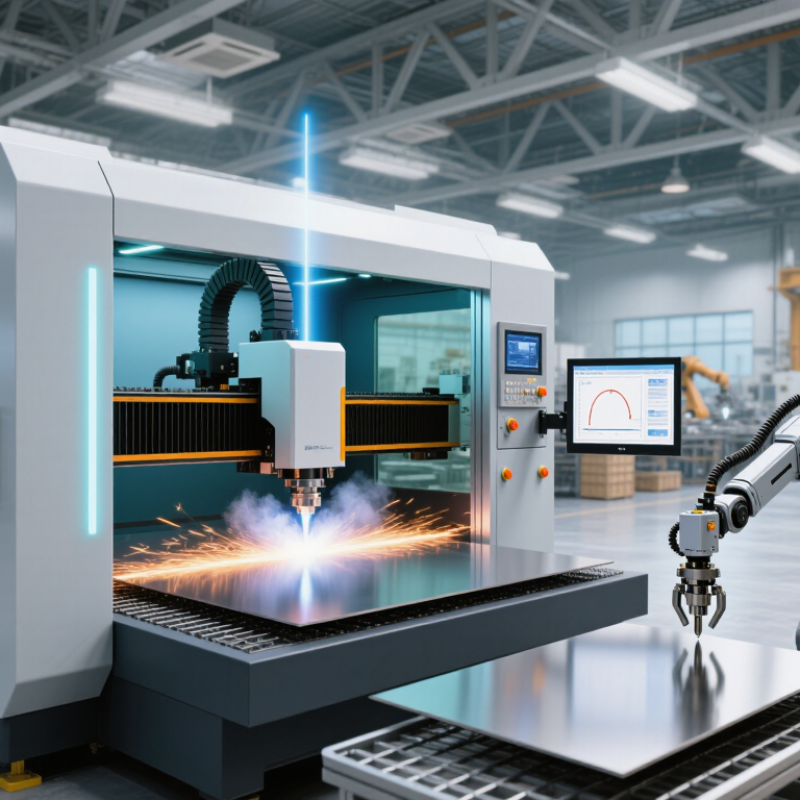
| Basic Principle | Laser cutting process | A focused, high-energy beam locally melts, vaporizes, or ignites the workpiece while an assist gas removes the material. | The cutting head concentrates the beam into a small spot, producing a narrow kerf and a controlled heat-affected zone. | Precision profiling of sheet, plate, tube, and selected nonmetallic materials. |
| Laser Source | Fiber laser | Usually operates near 1.03–1.08 µm wavelength; industrial systems commonly range from approximately 1 kW to more than 20 kW. | Provides high electrical efficiency, strong beam quality, and fast cutting of many conductive metals. | Carbon steel, stainless steel, aluminum, copper, brass, and production sheet-metal work. |
| Laser Source | Carbon dioxide laser | Typically operates at a wavelength of 10.6 µm; power levels from several hundred watts to multiple kilowatts are common. | Uses a gas mixture as the gain medium. It is effective for many organic materials and nonmetallic sheets, as well as some metals. | Acrylic, wood, textiles, plastics, paper, composites, and selected metal applications. |
| Laser Source | Solid-state laser | Often operates near 1.06 µm and may use crystal-based gain media or related solid-state technology. | Offers a compact beam source for precision processing, marking, thin-sheet cutting, and specialized manufacturing. | Thin metals, electronic components, medical parts, and precision fabrication. |
| Beam Delivery | Optical system | Includes mirrors or optical fibers, a focusing lens, a protective window, and a height-sensing cutting head. | Maintains beam alignment and focuses the energy at the correct position above or within the material surface. | Automated 2D cutting, tube cutting, bevel cutting, and high-repeatability production. |
| Motion System | CNC positioning | Computer-controlled X-Y motion is standard; three-axis, five-axis, and rotary-axis configurations are also used. | The controller converts a digital part file into coordinated machine movements and laser commands. | Flat-sheet profiling, three-dimensional components, tubes, pipes, and formed parts. |
| Cutting Method | Fusion cutting | The laser melts the material, while nitrogen or another inert gas ejects the molten metal. | Produces clean, oxide-reduced edges and is widely used when paintability, welding, or corrosion resistance is important. | Stainless steel, aluminum, galvanized steel, and other alloy sheets. |
| Cutting Method | Flame cutting | Oxygen assists combustion and removes molten material from the kerf. | Generally supports high cutting speeds in carbon steel, but the resulting edge may contain an oxide layer. | Carbon-steel plates, structural components, machinery parts, and general fabrication. |
| Cutting Method | Sublimation cutting | The laser vaporizes the material with limited melting; an inert gas helps clear the vapor and debris. | Useful when minimizing melt residue is more important than achieving maximum cutting speed. | Thin metals, plastics, wood, textiles, ceramics, and precision micro-components. |
| Assist Gas | Nitrogen | Inert gas commonly supplied at comparatively high pressure, depending on material, thickness, nozzle, and power. | Reduces oxidation and can produce bright, clean edges on stainless steel and aluminum. | Stainless-steel parts, aluminum enclosures, visible surfaces, and components prepared for welding. |
| Assist Gas | Oxygen | Reactive gas used when additional heat from oxidation can improve carbon-steel cutting. | Increases cutting energy through an exothermic reaction but normally leaves an oxidized edge. | Carbon-steel plate, brackets, frames, agricultural equipment, and structural parts. |
| Assist Gas | Compressed air | Filtered and dried shop air can be used for selected materials and thicknesses. | Can reduce gas cost, although edge quality, dross, and oxidation may differ from nitrogen or oxygen cutting. | General-purpose mild steel, stainless steel, aluminum, prototypes, and cost-sensitive production. |
| Material | Carbon steel | One of the most widely processed metals; practical thickness depends strongly on laser power, grade, and machine configuration. | Usually cut with oxygen for productivity or nitrogen when a lower-oxidation edge is required. | Frames, brackets, automotive components, machinery, construction parts, and enclosures. |
| Material | Stainless steel | Commonly processed from thin sheet to heavy plate on high-power industrial systems. | Often cut with nitrogen to limit oxidation and preserve edge appearance and corrosion performance. | Food-processing equipment, medical products, architectural parts, tanks, and industrial enclosures. |
| Material | Aluminum and aluminum alloys | Reflective and thermally conductive; requires suitable wavelength, power, focus, and process settings. | Fiber lasers are widely used because their beam characteristics support efficient processing of many aluminum grades. | Transportation components, heat exchangers, electronics housings, aerospace parts, and lightweight structures. |
| Material | Copper and brass | Highly reflective and thermally conductive; cutting performance depends on laser wavelength, power, and machine safeguards. | Modern high-power fiber systems can process these materials, but reflection control and stable parameters are important. | Busbars, electrical components, heat-transfer parts, plumbing fittings, and decorative hardware. |
| Material | Nonmetallic materials | Wood, acrylic, rubber, paper, textiles, and some plastics can be processed, particularly with suitable CO₂ systems. | The beam may cut by vaporization, melting, or thermal decomposition; material composition affects fumes and edge quality. | Signage, packaging, furniture components, textile parts, prototypes, and decorative products. |
| Performance | Kerf width | Often approximately 0.1–1.0 mm, depending on beam diameter, focus, nozzle, material, and thickness. | A narrow kerf allows close nesting of parts and reduces material waste. | Sheet-metal nesting, intricate contours, small holes, and fine-detail components. |
| Performance | Dimensional accuracy | Industrial machines can commonly achieve positional accuracy and repeatability in the tens of micrometers to low hundred-micrometer range, depending on machine design and conditions. | Accuracy is affected by calibration, thermal expansion, workholding, material flatness, and cutting parameters. | Automotive, aerospace, electronics, appliance, and precision machinery manufacturing. |
| Automation | Material handling | Options include pallet changers, sheet loaders, unloading systems, tube feeders, and automated storage interfaces. | Automation reduces loading time, operator handling, and interruptions between production cycles. | High-volume sheet-metal fabrication and lights-out or semi-automated production cells. |
| Industrial Application | Automotive and transportation | Used for steel, stainless steel, aluminum, and selected high-strength alloys. | Supports rapid design changes, nesting efficiency, and production of complex lightweight parts. | Body components, brackets, battery trays, exhaust parts, chassis components, and interior structures. |
| Industrial Application | Aerospace and defense manufacturing | Requires controlled processes, traceability, compatible materials, and strict inspection procedures. | Non-contact cutting reduces mechanical tooling forces and enables complex profiles in thin and medium-gauge materials. | Aircraft brackets, ducting, panels, structural fittings, and specialized assemblies. |
| Industrial Application | General metal fabrication | Processes a broad range of sheet and plate sizes with programmable cutting patterns. | Eliminates many dedicated dies and shortens setup time compared with conventional punching for varied part geometries. | Machine guards, cabinets, frames, brackets, panels, and custom-fabricated parts. |
| Industrial Application | Electronics and electrical equipment | Typically uses precision cutting of thin metals and nonmetallic materials. | Fine beam control enables small features, narrow kerfs, and limited mechanical deformation. | Enclosures, heat sinks, busbars, mounting plates, switchgear parts, and instrument panels. |
| Industrial Application | Medical-device manufacturing | Often involves thin stainless steel, titanium, nickel alloys, and other controlled materials. | High precision and low mechanical contact support intricate components, provided that heat input and cleanliness are controlled. | Surgical instruments, implants, brackets, housings, and laboratory equipment. |
| Safety and Environment | Fume and fire control | Industrial systems generally require an enclosed work area, interlocks, fume extraction, filtration, and fire-prevention measures. | Cutting can generate fumes, particulates, reflected radiation, and localized heat, depending on the material and process. | Factory production environments complying with applicable workplace-safety requirements. |
| Limitations | Process constraints | Performance decreases with highly reflective materials, excessive thickness, poor surface condition, unsuitable plastics, or unstable gas and focus settings. | Correct material data, assist gas, focal position, power, speed, nozzle alignment, and cooling are required for consistent results. | Process development, prototype qualification, production optimization, and quality control. |