What Are the Top 10 Environmentally Friendly Fans?
Choosing a fan is about more than finding a cool breeze. Environmentally Friendly Fans can use less electricity, last longer, and reduce reliance on air conditioning when selected for the right room. But “eco-friendly” is not a universal rating. A product’s real impact depends on its energy use, airflow, materials, expected lifespan, and how easily it can be repaired.
This guide explores ten fan options and the practical details worth checking before you buy. It considers fan type, published power consumption, airflow specifications, noise, controls, and construction. Look for comparable measurements, such as airflow per watt, rather than relying on broad claims or attractive packaging. Check the product manual, warranty, and availability of replacement parts. Small details matter. A quiet motor may encourage longer use, while a poorly sized fan may disappoint even if its specifications look impressive.
There are trade-offs. A compact desk fan may suit one person, but it cannot move air through a large living room. A ceiling fan may circulate air effectively, yet installation and room height affect its usefulness. Product information can also be incomplete, so no ranking can capture every household’s needs. That is worth remembering. The selections ahead are intended as a clear starting point, not a promise that one model is best for everyone. Compare verified specifications with your own room, climate, and daily habits before deciding.
What Defines an Environmentally Friendly Fan?
What Defines an Environmentally Friendly Fan?
An environmentally friendly fan moves useful air with less electricity, lasts for years, and avoids unnecessary material waste. A useful comparison is airflow efficiency: cubic feet per minute (CFM) divided by watts. The U.S. Department of Energy’s ceiling-fan test procedure measures airflow and power, making this figure more informative than blade size alone. ENERGY STAR reports that certified ceiling fans can be up to 60% more efficient than conventional fan-and-light models. That difference matters during long summer evenings. Still, efficiency ratings cannot tell the whole story.
Motor design, repairability, packaging, and noise also shape a fan’s footprint. A quiet fan may run longer without being turned down, while replaceable parts can keep a damaged unit out of the bin. Look for clear wattage and airflow figures, durable construction, and controls that suit the room. A high-efficiency label helps, but it does not prove that every material is sustainable. That distinction is easy to overlook.
Tips: Compare CFM per watt at the speed you actually use. Check whether common parts can be replaced. Use the fan to feel cooler, then raise the air conditioner setting when practical; fans cool people, not empty rooms. A little inconvenient, perhaps—but operating habits count too.
What Are the Top 10 Environmentally Friendly Fans?
What Defines an Environmentally Friendly Fan?
Lower electricity use can reduce a fan’s operating footprint. The chart compares calculated annual energy use at ten power levels, assuming each fan runs 8 hours per day for 365 days.
How to read this: Annual use is calculated as watts × 8 hours × 365 days ÷ 1,000. These are usage scenarios, not measurements of specific fan models. To compare real fans, check both their airflow and power draw: more airflow per watt (CFM/W) indicates greater efficiency.
How to Assess Energy Use and Sustainable Design
What Are the Top 10 Environmentally Friendly Fans?
How to Assess Energy Use and Sustainable Design
A fan’s wattage tells you how much electricity it draws, but not how much air it moves. Compare airflow per watt, often listed as CFM/W, when specifications are available. Higher airflow efficiency can mean more cooling for the same energy use. Check several speed settings, too. A fan may be efficient on low but less so at full power. If the figures are missing, a plug-in energy meter can help you measure actual use at home. Small differences add up over long summer evenings.
Tips: Match fan size to the room, and use a timer or thermostat control to avoid running it in an empty space. Clean the blades and grille regularly; dust can reduce airflow. Compare noise levels before buying, since a fan that is too loud may go unused. That part is easy to overlook.
Sustainable design includes more than low electricity use. Look for durable construction, replaceable parts, clear repair instructions, and packaging with less unnecessary material. A sturdy fan that lasts longer may be a better choice than a cheaper model that is difficult to repair. Still, material labels can be vague, and “eco-friendly” claims do not always explain the full product life cycle. Check the details, and treat missing information as a reason to compare carefully.
What Are the Top 10 Environmentally Friendly Fans? - How to Assess Energy Use and Sustainable Design
| Rank | Fan type | Typical input power | Estimated seasonal electricity use | Sustainable design features to look for | Assessment |
| 1 | DC ceiling fan | 5–35 W | 4.8–33.6 kWh | Efficient DC motor, multiple speed settings, replaceable parts, durable blades | Often a strong choice for circulating air across a regularly used room; match fan size to the room. |
| 2 | DC table fan | 5–25 W | 4.8–24.0 kWh | Low-power motor, stable reusable housing, accessible controls and serviceable components | Uses little electricity when aimed at one person, avoiding the need to cool an entire space. |
| 3 | DC pedestal fan | 10–35 W | 9.6–33.6 kWh | Efficient motor, adjustable height and airflow, washable grille, replaceable control or motor parts | Useful for directed personal or room airflow; speed control helps avoid unnecessary power use. |
| 4 | DC wall-mounted fan | 10–35 W | 9.6–33.6 kWh | Low-power motor, oscillation control, long service life, repairable mounting and electrical components | Can provide targeted airflow without taking up floor space; installation and room layout affect performance. |
| 5 | AC ceiling fan | 15–90 W | 14.4–86.4 kWh | Efficient motor, durable construction, replaceable blades, suitable size and reversible operation where useful | A well-sized model can circulate air throughout a room. Power varies considerably with speed and design. |
| 6 | AC table fan | 10–40 W | 9.6–38.4 kWh | Sturdy housing, simple controls, replaceable parts and an accessible grille for cleaning | A practical low-energy option for personal airflow, though power draw depends on the selected speed. |
| 7 | Tower fan | 25–60 W | 24.0–57.6 kWh | Low-power operation, washable filters if fitted, repairable controls and a durable casing | Compact and convenient, but compare its measured or nameplate wattage with other fan styles. |
| 8 | AC pedestal fan | 30–75 W | 28.8–72.0 kWh | Several useful speed settings, robust stand, replaceable components and a cleanable grille | Can move air effectively in a larger area; using a lower adequate speed can reduce electricity use. |
| 9 | Window fan | 40–100 W | 38.4–96.0 kWh | Efficient motor, reversible airflow, durable frame and controls that support intermittent use | Can help ventilate when outdoor conditions are suitable; its benefit depends on climate and placement. |
| 10 | Box fan | 40–100 W | 38.4–96.0 kWh | Simple repairable construction, durable grille, washable components and a motor suited to the intended use | Versatile for room airflow or ventilation, but typically draws more power than small personal fans. |
Estimates assume 8 hours of operation per day for 120 days (960 hours per season) and are calculated as input watts × 960 ÷ 1,000. Power ranges are broad typical values, not guarantees for every model; check the fan’s rating label or measured wattage for an accurate comparison. Rankings are a practical guide to potential energy savings and sustainable design, not a controlled product test. Exhaust and window fans provide ventilation rather than the same kind of direct room cooling as circulation fans.
Ten Fan Types That Reduce Environmental Impact
Choosing an eco-friendlier fan means matching airflow to the room, not simply buying the largest model. ENERGY STAR reports that certified ceiling fans with lights are, on average, 60% more energy-efficient than conventional fan-light units. The U.S. Department of Energy also says ceiling fans can let occupants raise a thermostat setting by about 4°F without reducing comfort.
That depends on people being in the room; fans cool people, not empty spaces. Switch them off when you leave.
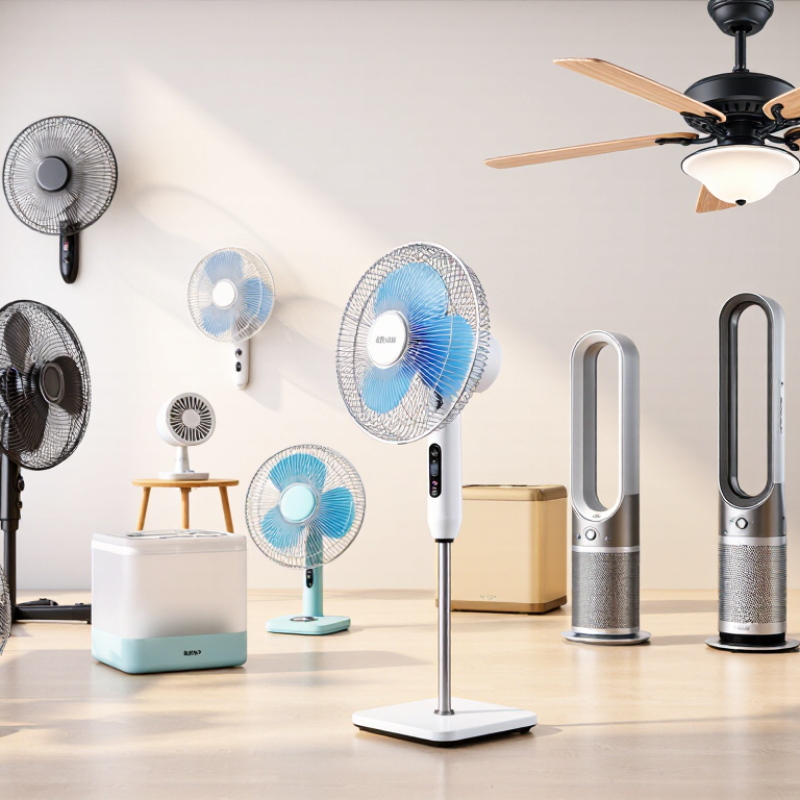
Ten useful types are ceiling fans, DC-motor ceiling fans, table fans, pedestal fans, tower fans, window fans, exhaust fans, whole-house fans, high-volume low-speed fans, and solar-powered fans. Efficient DC motors can cut a ceiling fan’s electricity use, while portable table and pedestal models direct air where it is needed.
Tower fans suit tight corners; window fans can bring in cooler outdoor air, and exhaust fans remove heat or moisture. Whole-house and high-volume fans serve larger spaces, but poor sizing can waste energy or create noise. Solar-powered models reduce grid use when sunlight matches operating hours.
Small details matter. A dusty grille, blocked window, or fan left running in an empty room undermines savings. Check measured airflow and wattage, not just the product label.
Comparing Performance, Materials, and Operating Costs
A fair top-ten comparison should include DC and efficient AC ceiling fans, desk, pedestal, tower, box, window, air-circulator, USB, and portable models. Compare useful airflow, measured in cubic feet per minute, against power draw—not blade size or marketing claims. ENERGY STAR’s ceiling-fan guidance reports that certified models use about 60% less energy than conventional fan-and-light units. That benchmark helps, but it does not rank every fan type equally.
Operating costs are easy to estimate. The U.S. Energy Information Administration reported an average residential electricity price of 16.48 cents per kilowatt-hour in 2024. A 30-watt fan running eight hours daily would use about 88 kilowatt-hours yearly, costing roughly $14.50 at that rate. A 50-watt model would cost about $24. Actual bills vary by location and use. Small loads add up.
Materials matter, but avoid treating one recycled component as proof of a greener product. The International Aluminium Institute reports that recycling aluminium requires about 95% less energy than producing primary aluminium; that figure applies to the metal, not the fan’s full lifecycle. Look for durable housings, replaceable controls, and accessible repair parts. A lower-priced fan may be harder to repair, while a premium finish may add little efficiency. One blind spot in simple comparisons: airflow tests rarely reflect every room’s layout, so check performance where the fan will actually run.