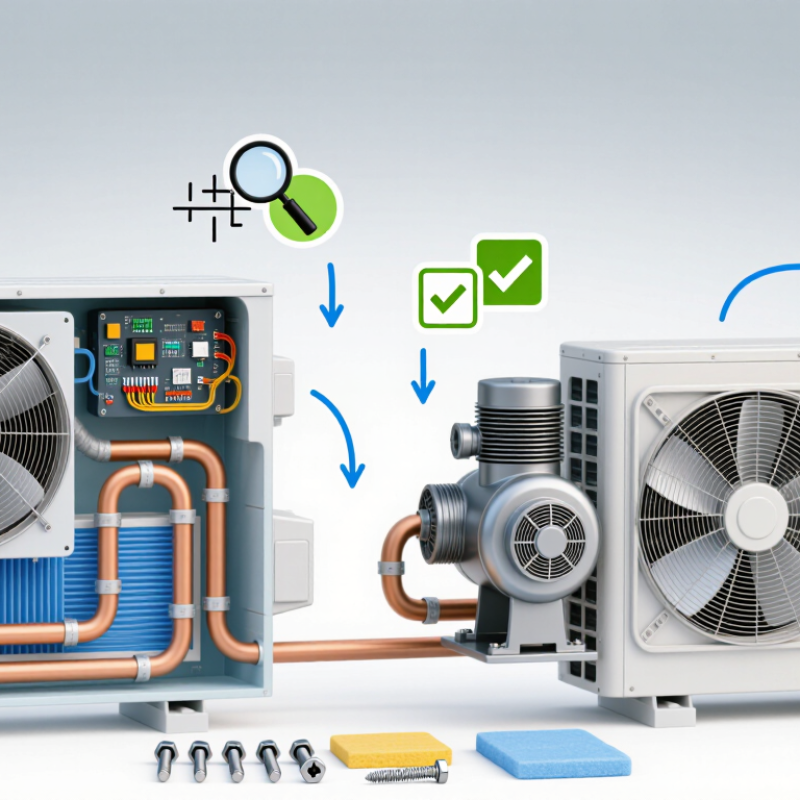
Choosing reliable Air Conditioner Parts from China requires more than comparing prices or browsing polished supplier catalogs. Experienced HVAC buyers examine compressor performance, copper tube quality, condenser coils, evaporator assemblies, fan motors, control boards, filters, and installation accessories. Each component affects cooling capacity, energy use, noise, and service life. Small defects can become expensive failures.
A dependable evaluation starts with clear technical requirements. Buyers should check model compatibility, refrigerant specifications, voltage, operating temperature, material grades, and expected working hours. Factory experience matters too. Production records, sample testing, quality-control procedures, and traceability provide stronger evidence than marketing claims. Independent inspections can reveal uneven brazing, weak terminals, poor insulation, or inconsistent coil coatings before shipment.
Details matter greatly.
Relevant certifications and market requirements should be verified for the destination country. However, certificates alone do not prove consistent quality. A supplier may pass one inspection and still struggle with later batches. That uncomfortable possibility deserves attention. Comparing samples from different production runs can expose variation. Field feedback from technicians also adds practical value, especially for compressors, motors, and electronic boards.
This guide explores the top Air Conditioner Parts commonly sourced from China and explains where each part fits in a complete system. It considers performance, durability, compatibility, maintenance, and supplier reliability. The goal is not to praise every manufacturer. It is to provide a balanced framework for making informed purchasing decisions, reducing avoidable risks, and selecting components that perform reliably in real operating conditions.
China’s air-conditioner supply chain covers both core components and smaller service parts. Common products include rotary and scroll compressors, copper tube heat exchangers, axial fan motors, expansion valves, capacitors, filters, sensors, and control boards. Manufacturers also produce aluminum fins, sheet-metal housings, drain pumps, insulation, and refrigerant piping. These parts support split, window, portable, rooftop, and variable-refrigerant-flow systems.
The compressor is the system’s heart, while the heat exchanger transfers heat through tightly spaced metal fins.
Control boards manage temperature, fan speed, protection functions, and communication between indoor and outdoor units.
The International Energy Agency reported that global space-cooling electricity demand could rise from about 2,020 TWh in 2016 to 6,200 TWh by 2050. This growth increases demand for efficient motors, reliable inverters, and better sensors.
The 2023 Global Cooling Watch report also identified efficiency as a major route for reducing future cooling emissions. However, part quality can vary. A cheaper capacitor may pass an initial test but fail under high heat.
Tips: Check voltage, refrigerant compatibility, dimensions, insulation quality, and test records before purchasing. Ask for batch traceability and performance data. Do not judge a component by appearance alone. One overlooked connector can stop an entire unit. Procurement teams should also compare independent laboratory results with factory claims, because published figures are not always perfectly comparable.
Chinese air-conditioner components are increasingly defined by copper, aluminum, engineering plastics, and embedded control technology. Copper tubing carries refrigerant through brazed joints, while aluminum fins expand the heat-transfer surface. Many factories use microchannel heat exchangers to reduce weight and refrigerant volume. The International Energy Agency reports that global space-cooling demand could more than triple by 2050, reaching about 6,200 TWh annually. Material efficiency is no longer a minor design choice.
In compressor production, variable-speed inverter systems are becoming standard in energy-conscious applications. They adjust motor speed instead of repeatedly switching on and off. This can improve temperature stability and reduce starting-current stress. Power modules, sensors, and control boards must survive humidity, vibration, and frequent cycling. A practical inspection should include tube-wall thickness, fin spacing, weld quality, insulation density, and controller response. Small defects matter.
Refrigerant selection is also changing. UNEP’s Kigali Amendment assessment encourages lower-global-warming alternatives, including R32 and hydrocarbons such as R290, where safety requirements are properly managed. China’s component suppliers increasingly design valves, compressors, and heat exchangers around these refrigerants. However, higher efficiency claims need independent testing under recognized conditions, such as ISO 5151 procedures. That assumption is too neat. Real performance can fall when filters clog, voltage fluctuates, or outdoor coils collect dust. Nakne
Chinese air conditioner parts are manufactured through tightly controlled metalworking, molding, and assembly processes. Copper tubes are cut, expanded, and cleaned before brazing. Aluminum fins are stamped with precise spacing to improve heat transfer. Plastic housings and drain trays are injection-molded, while motors and control components undergo separate electrical inspections.
Factory technicians usually check tube dimensions, fin alignment, surface defects, and connection strength. Refrigerant circuits are pressure-tested with dry nitrogen, then checked for leaks using electronic detectors or helium methods. Electrical parts receive insulation, grounding, voltage, and endurance tests. Finished assemblies may also undergo airflow, noise, vibration, and temperature testing inside controlled rooms.
Details matter. A small burr can restrict refrigerant flow. Poorly cleaned tubing can damage a compressor. During practical factory audits, inspectors often compare test records with random samples from the production line. This helps confirm that paperwork reflects real output. Still, no inspection is perfect. Sampling can miss an occasional weak joint, especially during rushed production. Better factories keep batch codes, calibration records, and traceable worker checks. Independent testing can add confidence, particularly for high-use parts exposed to humidity, heat, and repeated vibration. There is always room for stricter review.
Chinese air-conditioner manufacturing commonly involves compressors, copper heat-exchanger coils, expansion devices, fans, motors, control boards, filters, and sheet-metal housings. The chart compares the normal boiling points of widely used refrigerants that influence the design and testing of compressors, coils, and expansion devices.
Refrigerant boiling points are measured at approximately 1 atmosphere. During production, parts are typically checked for dimensional accuracy, leak tightness, electrical safety, airflow, vibration, and performance under controlled temperature and pressure conditions.
What Are the Top Air Conditioner Parts from China?
Different cooling systems need different parts, and compatibility matters more than low purchase price. China supplies compressors, copper coils, expansion valves, fan motors, sensors, filters, and control boards for many applications. For wall-mounted split systems, inverter compressors, electronic expansion valves, and compact fan motors usually support efficient room cooling. A 2023 International Energy Agency report notes that space-cooling demand could more than triple by 2050. Reliable replacement parts will become increasingly important.
VRF systems require precise communication boards, branch controllers, pressure sensors, and oil-compatible compressors. These parts must match refrigerant type, voltage, capacity, and the original communication protocol. For chillers, technicians often select scroll or screw compressors, condenser coils, variable-speed drives, and water-flow sensors. Rooftop units may need stronger fan motors, washable filters, and weather-resistant control enclosures. Fit matters.
Technical records should be checked before ordering. The U.S. Department of Energy reports that cooling equipment efficiency depends heavily on correct sizing, airflow, and installation quality. A high-efficiency part cannot repair a poorly designed system. This is where buyers sometimes make mistakes. A low-cost universal control board may appear suitable, but software differences can cause unstable operation. In field inspections, photographs, model numbers, wiring diagrams, and refrigerant data are more useful than assumptions. Independent testing reports and traceable factory documents also improve reliability, although paperwork alone is not proof of performance.
What Are the Top Air Conditioner Parts from China?
Chinese manufacturers supply compressors, fan motors, control boards, capacitors, filters, thermostats, and copper coils. Buyers should evaluate each part by application, not price alone. A compressor may look suitable, yet its voltage, refrigerant type, cooling capacity, and connection size must match the system. Small details matter. Request technical drawings, material specifications, test reports, and sample units before placing a large order. Check insulation, terminal strength, soldering quality, and surface protection on every sample.
Compatibility requires more than comparing model numbers. Confirm operating temperature, electrical frequency, mounting points, pipe dimensions, communication protocols, and replacement requirements. A control board may function during testing but fail after voltage fluctuations. That risk deserves attention. Supplier reliability also needs evidence. Review factory certifications, inspection procedures, production equipment, response speed, and experience with similar parts. Video audits and third-party inspections can reveal storage problems or inconsistent assembly. A polished catalog is not proof of stable production.
Tips: Test samples under realistic conditions, including heat, vibration, and repeated starts. Ask for batch records and a clear warranty process. Compare at least three suppliers using the same specification sheet. Keep written approval for every design change. Avoid choosing the cheapest offer without checking failure costs. No checklist is perfect. Recheck critical parts before shipment.
| Air Conditioner Part | Typical Product Data | Compatibility Factors | Key Quality Checks | Recommended Buyer Documents | Supplier Evaluation Points |
|---|---|---|---|---|---|
| Copper Tubes and Fittings | Refrigeration-grade copper tubing is commonly supplied in soft coils or hard straight lengths. Common sizes include approximately 6.35 mm, 9.52 mm, 12.70 mm and 15.88 mm outside diameter. | Match the liquid and suction-line diameters, wall thickness, connection type, refrigerant system, working pressure and installation method. | Check dimensional tolerance, tube cleanliness, internal oxidation, surface defects, flare quality, pressure resistance and leak-test results. The material should be suitable for refrigeration service. | Material certificate, dimensional inspection report, pressure or leak-test report and packaging photos. | Evaluate traceability of raw material, consistency between batches, moisture-proof packaging and the supplier's ability to provide cut-to-length or customized fittings. |
| Compressors | Rotary compressors are widely used in small split and residential systems, while scroll compressors are commonly used in larger-capacity applications. Capacity depends on displacement, refrigerant and operating conditions. | Confirm refrigerant type, rated voltage, frequency, phase, cooling capacity, oil type, starting method, mounting dimensions, discharge temperature and operating envelope. | Review insulation resistance, winding resistance, vibration, noise, starting current, cooling capacity, power input and high-temperature operating performance. | Performance test report, electrical safety report, operating-envelope data, dimensional drawing and warranty terms. | Prefer suppliers with controlled testing facilities, serial-number traceability, stable packaging and documented handling procedures for oil-filled components. |
| Expansion Valves and Capillary Tubes | Electronic expansion valves provide variable refrigerant flow control. Capillary tubes provide fixed flow restriction and are generally used in simpler, fixed-capacity systems. | Match valve capacity, port size, coil voltage, control signal, refrigerant, pressure range and system load. Capillary selection depends on tube diameter, length, refrigerant and design conditions. | Check flow repeatability, response time, valve shut-off performance, coil resistance, dimensional accuracy and cleanliness of the internal passage. | Flow-test data, electrical specifications, control protocol information, dimensional drawings and sample approval records. | Assess engineering support, availability of calibration data and the supplier's ability to provide matched components rather than generic parts with uncertain flow characteristics. |
| Heat Exchanger Coils | Evaporator and condenser coils typically use copper tubes with aluminum fins. Important design variables include tube diameter, fin spacing, coil rows, face area and circuit arrangement. | Match cooling or heating capacity, airflow, refrigerant, working pressure, cabinet dimensions, fan position, condensate drainage and connection locations. | Inspect fin uniformity, tube expansion, brazed joints, corrosion protection, air-side pressure drop, refrigerant leakage and condensate drainage performance. | Coil drawing, capacity test data, leak-test record, fin and tube material information and corrosion-test data where required. | Review tooling control, brazing quality, fin-forming accuracy, protective packaging and the supplier's ability to reproduce the approved sample. |
| Fan Motors and Blowers | Common configurations include indoor cross-flow blowers, outdoor axial fans and electronically controlled motors. Rated values vary by voltage, speed, airflow and motor design. | Confirm voltage, frequency, phase, shaft or mounting dimensions, rotation direction, speed-control method, connector type, airflow requirement and noise limit. | Test insulation, locked-rotor protection, current draw, speed stability, vibration, bearing noise, temperature rise and airflow at the intended static pressure. | Motor data sheet, wiring diagram, airflow-performance curve, safety test report and vibration or noise test results. | Check production consistency, motor balancing equipment, incoming-material controls and protection against shaft or bearing damage during transportation. |
| Printed Circuit Boards and Controllers | Control boards may manage compressor operation, fan speed, sensors, defrost functions, communication and protection logic. Inverter systems require control electronics compatible with the power module and motor. | Match the exact unit model, firmware, connector layout, sensor curve, supply voltage, communication protocol, power rating and safety functions. | Inspect component placement, solder quality, conformal coating where specified, insulation spacing, surge protection, temperature testing and functional-test coverage. | Circuit diagram, firmware or parameter record, functional-test report, component approval list and electrostatic-discharge handling procedure. | Evaluate engineering change control, firmware version management, after-sales troubleshooting support and protection of design files and technical information. |
| Capacitors | AC motor-run capacitors are selected by capacitance, rated voltage, frequency, temperature range and duty cycle. Common applications include compressor and fan motors. | Match capacitance tolerance, rated voltage, terminal style, can dimensions, temperature class and the motor manufacturer's electrical requirements. | Verify capacitance, dissipation factor, insulation resistance, self-healing behavior, pressure-disconnect protection and endurance at elevated temperature. | Capacitance test report, safety certification applicable to the destination market, endurance data and lot traceability. | Confirm dielectric-material consistency, date-code control, moisture protection and clear separation of approved and non-approved production lots. |
| Refrigerant Filters and Filter Driers | Filter driers remove moisture, acid and particulate contamination from refrigeration circuits. Selection depends on refrigerant, system capacity, connection size and required moisture capacity. | Match refrigerant compatibility, flow direction, connection type, pressure rating, moisture capacity and installation position. | Check pressure drop, shell integrity, desiccant containment, particle filtration, internal cleanliness and resistance to vibration and temperature cycling. | Pressure-rating information, flow data, moisture-capacity data, leak-test report and material declaration. | Assess sealing quality, contamination control, end-cap protection and shelf-life management for desiccant components. |
| Air Filters | Common air filters include washable mesh, pleated synthetic media and other application-specific filter materials. Performance is determined by filtration efficiency, airflow resistance and dust-holding capacity. | Match filter dimensions, frame design, airflow direction, target particle size, pressure drop, cleaning method and indoor-air-quality requirements. | Measure dimensions, media uniformity, airflow resistance, filtration performance, frame strength, odor characteristics and resistance to moisture or repeated washing where applicable. | Filtration test report, pressure-drop curve, material safety information and dimensional inspection report. | Review raw-material traceability, cleanliness of the production area, cutting accuracy and packaging that prevents deformation or contamination. |
| Sensors and Thermistors | Temperature sensors commonly use negative-temperature-coefficient thermistors. Typical resistance values and accuracy depend on the control design and sensing location. | Match resistance-temperature curve, tolerance, probe dimensions, cable length, connector, operating range and controller software settings. | Check resistance at defined temperatures, response time, insulation, waterproofing, cable pull strength and long-term drift. | Resistance-temperature curve, calibration report, connector drawing, environmental test data and lot identification. | Favor suppliers with calibrated test equipment, controlled crimping processes and documented sensor matching procedures. |
| Remote Controls and Display Modules | Components may include infrared remote controls, wired controllers, display panels and receiver boards. Functions vary according to system architecture. | Match communication method, code or protocol, display layout, connector, operating voltage, language requirements and supported functions. | Verify transmission range, button reliability, display readability, connector durability, battery leakage protection and operation across the specified temperature range. | Functional test record, user-interface specification, dimensional drawing, electrical data and packaging specification. | Evaluate firmware or code control, tooling stability, labeling accuracy and the supplier's capacity for replacement-unit continuity. |
| Electrical Contactors and Relays | Contactors and relays switch compressor, fan, heater and auxiliary circuits. Selection depends on coil voltage, contact arrangement, load type and switching frequency. | Match coil voltage, contact rating, motor or resistive load, number of poles, mounting dimensions, terminal arrangement and applicable electrical requirements. | Test contact resistance, dielectric strength, insulation resistance, pickup and dropout voltage, temperature rise and electrical endurance. | Electrical ratings, endurance-test data, safety test report, wiring diagram and incoming-inspection criteria. | Check contact-material consistency, lot traceability, terminal torque control and protection from moisture and dust during shipment. |

Northeast Battery, a Stored Energy Holdings, Inc. Company