
China’s Tech Rosewood Acoustic Slat Panel market combines decorative craftsmanship with measurable sound control. The best suppliers do more than present attractive wood grain. They explain core materials, backing systems, installation methods, and acoustic test results. This matters in offices, recording rooms, hotels, restaurants, and private residences.
Trevor Cox, a professor of acoustic engineering and respected acoustics author, has said, “Acoustics is about making spaces work for people.” His point fits this product category closely. A rosewood-look surface may warm a room visually, but the panel’s felt backing, cavity depth, slat spacing, and wall structure influence real performance. A supplier should provide more than polished photographs.
Look closely.
This guide reviews China’s top ten Tech Rosewood Acoustic Slat Panel suppliers through practical purchasing criteria. These include manufacturing experience, veneer consistency, panel density, fire-performance documentation, moisture resistance, acoustic reports, customization capacity, packaging, and export support. Sample checks are essential. A small color difference can become obvious across a 30-meter feature wall.
No supplier is perfect. Some publish limited test data. Others offer impressive customization but weaker installation guidance. That uncertainty deserves attention, not marketing language. The strongest companies show production samples, clarify tolerances, and communicate limitations honestly. Buyers should also confirm whether laboratory ratings match the complete installed system.
The following supplier overview aims to support informed comparison. It favors evidence, site suitability, and long-term reliability over appearance alone. Expect useful strengths, possible weaknesses, and a few details that require further verification.
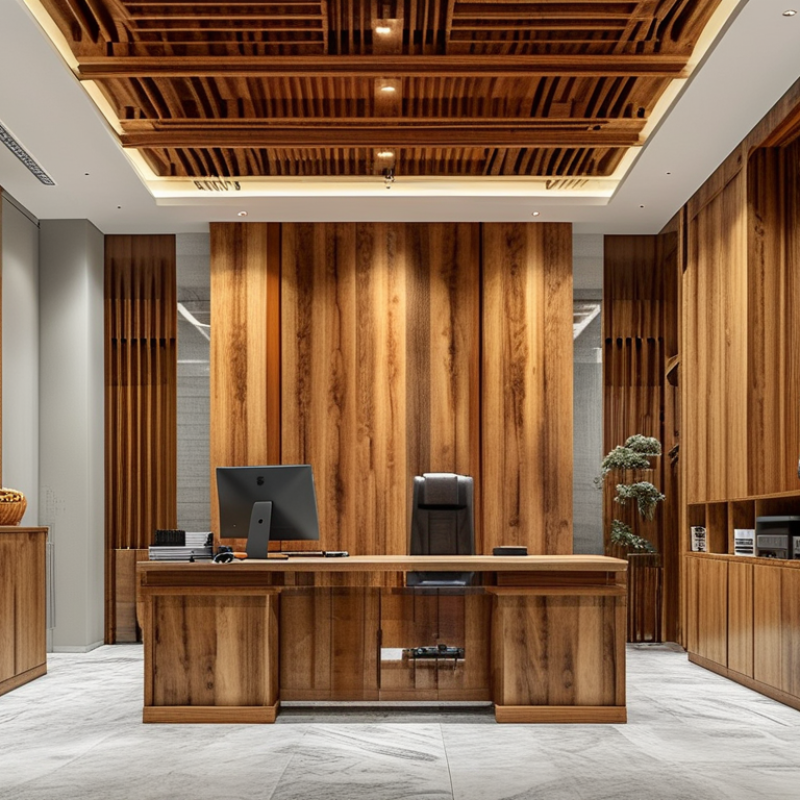
Rosewood acoustic slat panels combine a decorative timber surface with a sound-absorbing core. Narrow slats create controlled gaps across the wall. Behind them, mineral wool or recycled PET usually captures reflected sound. A dark acoustic fleece also closes visual gaps. The rosewood layer mainly adds warmth, not absorption. The backing performs the acoustic work.
ASTM C423 laboratory testing often reports NRC values between 0.70 and 0.95 for slatted systems with suitable backing. Results depend on cavity depth, insulation density, and installation spacing. ISO 354 testing measures sound absorption in a reverberation room. ISO 11654 then classifies the absorber from measured performance. These figures are not promises for every room. Furniture, doors, and ceiling height can change the result.
A 2024 acoustic-panels market analysis identifies offices, hospitality spaces, and education buildings as major demand areas. That trend reflects a practical problem: hard surfaces produce long reverberation and unclear speech. Rosewood panels help by reducing mid- and high-frequency reflections. Wider cavities can improve lower-frequency absorption. Installation errors remain common. A sealed air gap may weaken performance. Excessively dense slats can also reduce exposed absorption area. I would specify documented timber sourcing, moisture control, and independent laboratory results before approval. The appearance is impressive. The acoustic claim needs evidence.
China Top 10 Tech Rosewood Acoustic Slat Panel Suppliers
Key Standards for Evaluating Chinese Acoustic Slat Panel Suppliers
Evaluating Chinese acoustic slat panel suppliers requires more than comparing online prices. Start with material evidence. Ask whether the rosewood finish is solid timber, veneer, or printed foil. Request species details, legal sourcing records, and batch photographs. A reliable supplier should provide clear product data, not vague descriptions.
Acoustic performance needs independent verification. Review test reports for sound absorption, panel thickness, and frequency ranges. Check the testing laboratory, report date, and sample size. A strong result at one frequency does not guarantee quiet rooms. Ask for results under conditions similar to your project. Room size matters.
Fire safety and formaldehyde emissions also require documented testing. Confirm standards accepted in the destination market. Inspect backing felt density, slat spacing, adhesive quality, and edge finishing. Small gaps can affect appearance and installation time. They may also weaken acoustic consistency.
Request a production sample before placing a large order. Measure slat width, color variation, panel weight, and mounting accuracy. Speak with the quality-control contact, not only a sales representative. Supplier audits should examine moisture control, packaging, traceability, and corrective-action records. References from comparable projects add useful evidence, but they are not perfect proof.
A polished showroom can mislead. We should question our own assumptions. A lower price may reflect thinner felt, unstable veneer, or weaker packaging. Delivery reliability, warranty terms, replacement procedures, and technical drawings deserve equal attention. Clear answers usually reveal more than attractive samples.
China’s Top 10 Tech Rosewood Acoustic Slat Panel Suppliers represent a competitive manufacturing segment for commercial and residential interiors. Many suppliers combine natural rosewood veneer, recycled PET felt, and precision-cut MDF cores. Their production experience often covers hotel lobbies, recording rooms, offices, and private cinemas. A reliable supplier should explain veneer sourcing, core density, slat spacing, and panel tolerances clearly.
Technical evidence matters more than polished photographs. Buyers should request acoustic test reports, fire-performance documents, formaldehyde data, and installation drawings. The reported acoustic result depends on the complete wall system, not the panel alone. Ceiling height, cavity depth, insulation, and room shape can change performance. Strong suppliers usually offer CNC cutting, moisture-control packaging, sample approval, and inspection records before shipment.
Details become visible during installation. Uneven wall surfaces may create small shadow gaps between panels. Rosewood grain also varies, so color matching needs practical limits. No factory gets every detail right. That is worth admitting. Suppliers that record defects, respond to measurement changes, and improve packaging show stronger professional discipline. The best choice among China’s top ten should balance verified performance, stable production, responsible material control, and useful technical support rather than relying only on low pricing.
China Top 10 Tech Rosewood Acoustic Slat Panel Suppliers
Supplier comparison should begin with measurable performance, not attractive photographs. Grand View Research reports that the global acoustic panels market is expanding steadily, driven by offices, hospitality spaces, and recording environments. For rosewood slat panels, buyers should request ISO 354 reverberation testing and ASTM C423 sound absorption results. The Noise Reduction Coefficient matters, but testing conditions matter more. A high NRC value from one assembly may not match a wall installation. Samples can mislead.
Technology separates capable suppliers from simple fabricators. Look for CNC-controlled slat spacing, moisture-resistant core options, and documented adhesive systems. Customization should cover slat width, veneer tone, fire performance, backing thickness, and perforation patterns. According to the International Energy Agency, buildings account for roughly 30% of global energy demand, making comfortable, efficient interiors increasingly important. Acoustic control supports that goal indirectly by reducing noise-related complaints and redesign work.
Quality depends on repeatability. Ask for veneer inspection records, dimensional tolerances, batch photos, and independent fire-test documents. EN 13501-1 classification may be relevant for many commercial projects, but local code approval remains essential. Capacity is different. A supplier may claim large monthly output while outsourcing coating or packaging. Request production schedules, equipment lists, and a recent factory audit. I would compare pilot orders before signing a large contract. That gap matters. Even experienced buyers sometimes overvalue catalog variety and undervalue stable delivery, especially during peak construction seasons.
| Rank | Supplier Profile | Core Technology | Panel Construction | Acoustic Performance | Customization Capability | Quality and Compliance | Production Capacity | Typical MOQ | Typical Lead Time | Best-Fit Applications | Overall Assessment |
|---|---|---|---|---|---|---|---|---|---|---|---|
| 01 | Supplier Profile 01 | Automated slat cutting, CNC grooving, precision edge trimming, and continuous lamination. | Real wood veneer over MDF slats mounted on a recycled PET acoustic felt backing. | NRC: 0.85–0.95 Effective absorption generally improves when installed over an air gap. | Slat width, spacing, veneer tone, backing color, panel length, perforation, and fire-retardant options. | Batch color inspection, dimensional checks, adhesive bonding tests, and formaldehyde-emission testing available. | Approximately 20,000–35,000 m² per month. | 100–300 m² | 20–30 days after approved sample. | Hotels, offices, conference rooms, cinemas, and premium residential interiors. | Strong all-round capability |
| 02 | Supplier Profile 02 | High-speed veneer pressing, automated panel sizing, and digital color matching. | Natural or engineered wood veneer on grooved MDF with acoustic polyester felt. | NRC: 0.75–0.90 Suitable for decorative wall and ceiling applications. | Custom veneer selection, slat geometry, edge profiles, panel dimensions, and project color matching. | Moisture testing, surface inspection, veneer matching, and carton drop testing. | Approximately 15,000–28,000 m² per month. | 150–400 m² | 25–35 days after design confirmation. | Commercial offices, retail stores, restaurants, education spaces, and residential projects. | Balanced customization and quality |
| 03 | Supplier Profile 03 | CNC-controlled profile machining, concealed fixing systems, and modular panel engineering. | Wood veneer-faced slats fixed to a black or colored PET felt acoustic substrate. | NRC: 0.80–0.90 Performance depends on panel spacing, backing, and installation conditions. | Curved modules, corner elements, ceiling baffles, integrated lighting cut-outs, and non-standard dimensions. | First-article approval, CNC dimensional verification, adhesive strength checks, and packing inspection. | Approximately 10,000–22,000 m² per month. | 50–200 m² | 30–45 days for engineered or curved designs. | Auditoriums, music rooms, hospitality interiors, feature walls, and complex architectural projects. | Best for engineered designs |
| 04 | Supplier Profile 04 | Automated sanding, UV or water-based finishing, and multi-stage veneer pressing. | Decorative wood veneer over stable MDF or fire-rated MDF with acoustic felt backing. | NRC: 0.70–0.85 Provides moderate to high sound absorption in occupied interiors. | Wide range of stains, gloss levels, veneer grades, slat spacing, and panel lengths. | Finish consistency testing, veneer surface grading, moisture control, and packaging verification. | Approximately 18,000–30,000 m² per month. | 200–500 m² | 20–35 days for standard specifications. | Large commercial fit-outs, residential developments, retail interiors, and public buildings. | Efficient for repeat orders |
| 05 | Supplier Profile 05 | Small-batch CNC manufacturing, manual veneer selection, and prototype-focused production. | Real wood veneer slats with PET felt or mineral-fiber acoustic backing. | NRC: 0.75–0.90 Suitable for decorative acoustic treatment in small and medium spaces. | Low-volume custom colors, mixed slat patterns, branded project colors, and sample development. | Manual visual grading, sample approval, dimensional inspection, and pre-shipment checks. | Approximately 5,000–12,000 m² per month. | 30–100 m² | 25–40 days depending on veneer and finish availability. | Boutique hotels, restaurants, private clubs, studios, and high-end residential projects. | Flexible for smaller projects |
| 06 | Supplier Profile 06 | High-throughput panel assembly, automated packing, and standardized modular production. | Veneered MDF slats on recycled PET felt, commonly supplied in modular rectangular panels. | NRC: 0.65–0.85 Reliable performance for general-purpose interior applications. | Standard color library, selected slat widths, standard panel sizes, and basic edge modifications. | Incoming-material inspection, production-line checks, carton testing, and loading supervision. | Approximately 25,000–45,000 m² per month. | 300–800 m² | 15–25 days for standard products. | Apartment projects, offices, retail chains, schools, and volume procurement programs. | Best for high-volume supply |
| 07 | Supplier Profile 07 | Fire-retardant substrate processing, low-emission adhesive systems, and controlled hot pressing. | Fire-rated MDF or plywood slats with decorative wood veneer and acoustic felt backing. | NRC: 0.70–0.90 Acoustic values vary according to substrate and mounting method. | Fire-rated cores, moisture-resistant substrates, custom veneer, edge treatments, and project-specific testing. | Fire-performance documentation, formaldehyde testing, moisture checks, and traceable batch records. | Approximately 12,000–25,000 m² per month. | 200–500 m² | 30–45 days when compliance testing is required. | Healthcare, transportation facilities, hospitality, public buildings, and regulated projects. | Strong compliance orientation |
| 08 | Supplier Profile 08 | Water-based finishing, recycled-material integration, and digitally controlled cutting. | Low-emission MDF or plywood slats combined with recycled PET acoustic backing. | NRC: 0.70–0.85 Designed for balanced decorative and acoustic performance. | Recycled felt colors, FSC-sourced wood options, low-VOC finishes, custom dimensions, and packaging reduction. | Material traceability, emissions documentation, surface inspection, and sustainability-related records. | Approximately 8,000–18,000 m² per month. | 100–300 m² | 25–40 days after material approval. | Green buildings, corporate interiors, wellness spaces, education projects, and eco-conscious homes. | Strong sustainability profile |
| 09 | Supplier Profile 09 | Standardized roll-to-panel processing, automated lamination, and export-oriented packing systems. | Engineered wood veneer over MDF slats with polyester felt acoustic backing. | NRC: 0.65–0.80 Appropriate for decorative sound control in offices and commercial interiors. | Standard veneer collection, selected felt colors, common panel sizes, and limited profile changes. | Visual inspection, panel squareness checks, adhesive inspection, and export packaging control. | Approximately 15,000–27,000 m² per month. | 300–600 m² | 20–30 days for standard products. | Importers, distributors, office fit-outs, residential developments, and contractor supply. | Competitive standard-product supplier |
| 10 | Supplier Profile 10 | Integrated design support, rapid prototyping, CNC shaping, and project-based production control. | Natural veneer, laminate, or painted slats installed on PET felt, MDF, or plywood backing. | NRC: 0.75–0.90 Performance is optimized through spacing and installation design. | Custom module shapes, mixed materials, curved sections, ceiling systems, color matching, and project mock-ups. | Prototype approval, production sample retention, dimensional inspection, finish checks, and final packing review. | Approximately 6,000–16,000 m² per month. | 50–200 m² | 30–50 days for fully customized projects. | Architectural studios, cultural venues, premium hospitality, showrooms, and signature interiors. | Best for design-led projects |
When comparing China’s top ten tech rosewood acoustic slat panel suppliers, inspect more than catalog photographs. Ask for veneer samples, core details, acoustic test results, and production records. Rosewood appearance can vary between batches, especially under different lighting. A reliable supplier explains these differences clearly. Check the panel’s NRC rating, slat spacing, felt density, moisture resistance, and edge accuracy. These details affect both sound control and installation quality.
Tips: Request a sample box before placing a large order. Compare the veneer tone, surface finish, and panel thickness under daylight. Ask whether testing covers the complete panel, not only the acoustic felt. Confirm fire, formaldehyde, and environmental documents for your destination market. Certificates alone are not enough.
Use a video factory inspection or an independent quality check when possible. Review how suppliers handle damaged cartons, replacement panels, and color inconsistencies. Clear packaging photographs can reveal weak corner protection. Also confirm minimum order quantities, sample charges, lead times, and loading plans in writing. A low price may hide thinner slats or unstable backing. Perfect matching is difficult, so define acceptable variation before production. I would not approve a large shipment from one sample alone. Check several panels from different cartons. That extra step can prevent costly rework.
Northeast Battery, a Stored Energy Holdings, Inc. Company