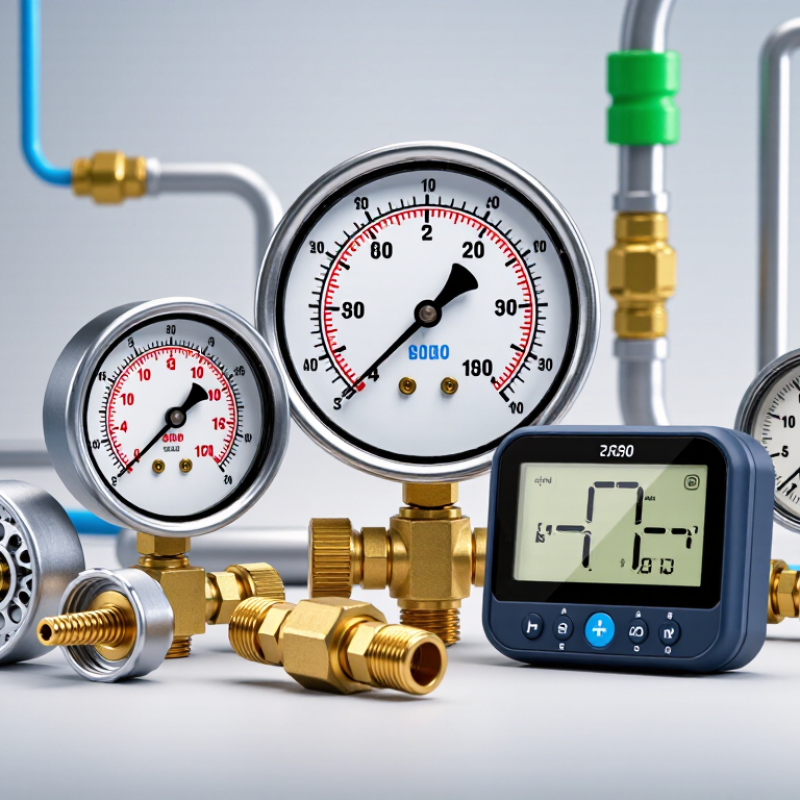
| Bourdon Tube Gauge | Gauge pressure, vacuum, or compound pressure | Approximately 0.6 to 1,600 bar, depending on construction | Typically ±0.5% to ±2.0% of full scale | Hydraulic systems, compressed air, pumps, compressors, process piping, and general industrial equipment | Air, water, hydraulic oil, steam, and other non-corrosive fluids; wetted materials must match the medium | Robust mechanical design, broad pressure coverage, no external power required, and generally economical | Can be affected by vibration, pulsation, temperature, and mechanical shock; not ideal for very low pressure | Choose the tube material, connection size, case protection, pressure range, and optional liquid-filled case according to service conditions |
| Diaphragm Gauge | Low to medium gauge pressure | Approximately 2.5 mbar to 40 bar | Typically ±1.0% to ±2.5% of full scale | Low-pressure gas systems, water treatment, filtration, burners, and corrosive or contaminated process service | Gas, liquid, viscous, contaminated, and corrosive media when suitable diaphragm and coating materials are used | Good sensitivity at low pressure and better resistance to clogging than narrow-bore sensing elements | Diaphragm overload, temperature changes, and corrosive attack can influence accuracy and service life | Check diaphragm material, chemical compatibility, overload protection, and whether a diaphragm seal is required |
| Capsule Gauge | Very low positive pressure or low vacuum | Approximately 0.6 mbar to 600 mbar | Typically ±1.0% to ±2.5% of full scale | Air-handling systems, clean gas measurement, laboratory equipment, gas burners, and ventilation systems | Clean, dry, low-pressure gases; material compatibility depends on the capsule and wetted components | High sensitivity for small pressure differences and low-pressure applications | Generally unsuitable for liquids, high pressure, pulsating service, or dirty and condensing gases | Confirm gas cleanliness, operating range, ambient temperature, and resistance to overpressure |
| Differential Pressure Gauge | Difference between two system pressures | Approximately 0 to 1,000 mbar differential pressure; higher ranges are available in specialized designs | Typically ±0.5% to ±2.5% of full scale | Filter monitoring, flow measurement, pump performance, ventilation, cleanrooms, and liquid-level measurement | Liquids or gases compatible with the sensing element and high- and low-pressure connections | Displays pressure drop directly and supports condition monitoring without calculating two separate readings | Static line pressure and excessive differential pressure may damage the sensing element; impulse lines can clog | Specify differential range, maximum static pressure, connection arrangement, diaphragm material, and pulsation level |
| Absolute Pressure Gauge | Pressure relative to a sealed vacuum reference | Approximately 0 to 25 bar absolute for common industrial instruments | Typically ±0.5% to ±1.0% of full scale | Vacuum process control, altitude testing, distillation, evaporation, aerospace testing, and barometric applications | Gas or liquid media compatible with the sensing system and process connection | Unaffected by changes in local atmospheric pressure, making readings comparable across locations | Usually costs more than standard gauge-pressure instruments and cannot indicate pressure relative to the local atmosphere | Confirm whether the process requires absolute, gauge, or compound reference and select an appropriate vacuum rating |
| Vacuum Gauge | Pressure below atmospheric pressure | From approximately 0 to −1 bar gauge; deep-vacuum versions may measure down to about 0.001 mbar | Typically ±0.5% to ±2.0% of full scale for mechanical designs | Vacuum pumps, packaging machines, suction systems, laboratory apparatus, and vacuum chambers | Clean gases and compatible process media; liquid service requires a suitable sensing design | Simple indication of vacuum level and easy integration into mechanical vacuum systems | Mechanical versions may have limited resolution at deep vacuum and can be affected by leaks, vibration, and temperature | Define the required vacuum depth, reference scale, response time, media compatibility, and connection orientation |
| Compound Gauge | Both positive gauge pressure and vacuum | Commonly from approximately −1 bar to 0.6–25 bar gauge | Typically ±1.0% to ±2.0% of full scale | Refrigeration, HVAC service, mobile equipment, pumps, and systems that alternate between pressure and suction | Air, refrigerants, water, oil, and other media approved for the selected wetted materials | Combines vacuum and positive-pressure readings in one instrument | Scale resolution is shared across two measurement zones, so it may be less precise than a dedicated gauge | Check refrigerant or process compatibility, pressure-temperature conditions, scale layout, and required vacuum range |
| Digital Pressure Gauge | Gauge, absolute, vacuum, or differential pressure, depending on sensor configuration | Commonly 0–bar to 0–1,000 bar; the available range depends on the sensor | Typically ±0.05% to ±0.5% of full scale | Calibration, test benches, energy systems, maintenance, process monitoring, and applications requiring data logging | Gas or liquid media compatible with the pressure sensor, diaphragm, and process connection | Clear numerical display, selectable units, peak-hold functions, and potentially higher resolution than mechanical gauges | Requires batteries or external power; electronics can be affected by temperature, moisture, electromagnetic interference, and shock | Review sensor accuracy, battery life, ingress protection, sampling rate, display readability, and calibration requirements |
| Sanitary Pressure Gauge | Gauge pressure in hygienic process systems | Commonly 0–1 bar to 0–40 bar, depending on process requirements | Typically ±0.5% to ±1.0% of full scale | Food and beverage processing, pharmaceutical production, biotechnology, and hygienic water systems | Clean-in-place and sterilize-in-place compatible liquids or gases, subject to seal and diaphragm material selection | Designed for cleanability, reduced contamination risk, and hygienic process connections | Higher purchase cost and more demanding installation requirements than general-purpose gauges | Verify connection standard, surface finish, elastomer compatibility, sterilization temperature, and hygienic certification requirements |
| High-Pressure Gauge | High positive gauge pressure | Commonly 400 to 4,000 bar; specialized instruments may cover higher pressures | Typically ±0.5% to ±1.0% of full scale | Hydraulic test equipment, water-jet systems, pressure testing, injection equipment, and high-pressure research | Hydraulic fluids, water, gases, and other media approved for the pressure boundary and seals | Reinforced pressure-containing components and improved safety for demanding pressure levels | Heavy construction, higher cost, and increased safety risks if the instrument is incorrectly selected or installed | Confirm maximum working pressure, overpressure rating, burst pressure, connection standard, mounting method, and protective accessories |