We can help!
800-441-8824

What Are the Top Pump Parts for Global Buyers?
Global buyers rarely judge Pump Parts by price alone. They examine fit, material quality, service life, and supplier consistency. A seal that looks inexpensive may fail quickly in abrasive water. A small dimensional error can stop an entire production line.
Dr. Heinz P. Bloch, a recognized machinery reliability expert, has stated, “Reliability begins with selecting the right component for the operating duty.” This principle guides the discussion. The most important Pump Parts often include mechanical seals, impellers, wear rings, bearings, gaskets, shafts, and couplings. Each part must match the pump model, fluid properties, temperature, pressure, and operating speed. Material choice matters. Stainless steel can resist corrosion better than ordinary steel. Ceramic faces may improve seal performance in demanding applications.
Fit matters more.
Reliable global sourcing also requires traceable drawings, inspection records, and clear technical communication. Buyers should confirm dimensions, tolerances, elastomer grades, and testing methods before placing orders. They should also ask how replacement parts are packaged for long-distance transport. Moisture damage is easy to overlook. So is poor labeling.
There is no universal best part. That assumption needs reconsideration. A component suitable for clean water may perform poorly with slurry, chemicals, or high-temperature fluids. Experienced buyers compare total operating risk, not only the invoice amount. They study failure patterns, maintenance access, delivery stability, and after-sales support. This article outline explores which Pump Parts matter most, how to evaluate them, and where purchasing decisions can quietly go wrong.
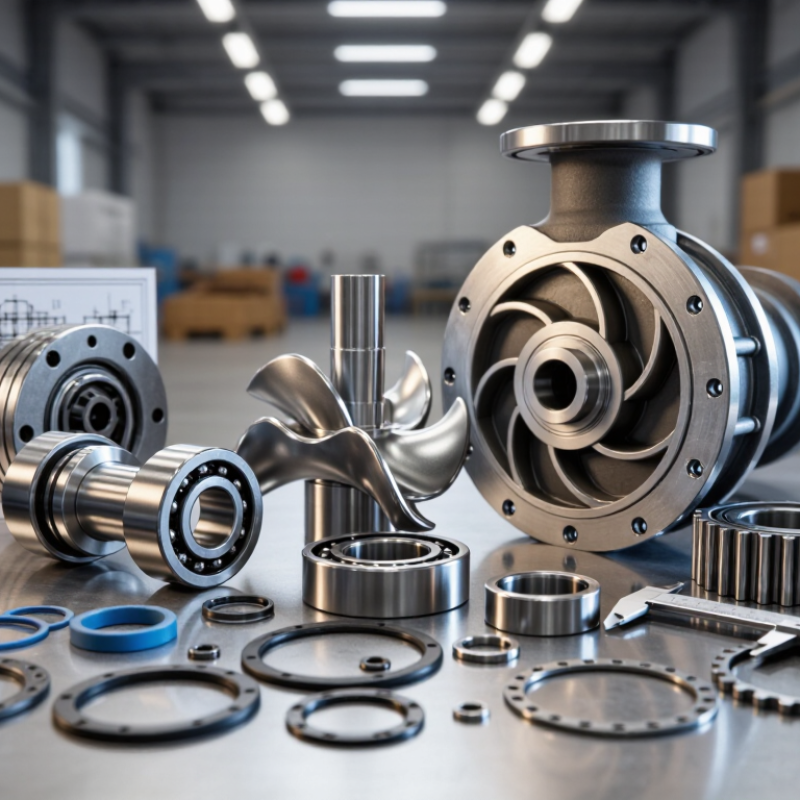
Table of Contents [Hide]
Pump Parts: Functions, Types, and Global Buying Priorities
What Are the Top Pump Parts for Global Buyers?
Pump parts control flow, pressure, sealing, and operating stability. Impellers move liquid through the casing. Mechanical seals prevent leakage around the rotating shaft. Bearings support alignment and reduce friction. Wear rings protect critical clearances, while gaskets maintain tight connections between stationary surfaces. Fit comes first.
Global buyers usually compare impellers, seals, shafts, bearings, couplings, valves, and repair kits. Each part requires accurate dimensions, material information, and operating data. Stainless steel may suit corrosive fluids, while reinforced polymers can reduce weight and resist certain chemicals. Selection still depends on temperature, pressure, fluid density, and solids content.
Numbers can mislead. A cheaper part may create faster wear, difficult installation, or unexpected downtime. I have seen buyers focus on purchase price and overlook shaft tolerance or seal compatibility. Do not guess. Ask for drawings, inspection records, test results, and traceable material documentation. Check whether the replacement matches the pump model, rotation direction, connection size, and duty cycle. Packaging also matters during long-distance shipping. Moisture barriers, protective caps, and clear labels can prevent avoidable damage. Regional technical requirements should be reviewed before purchase. They are not always identical. A reliable supplier should explain limitations honestly, including uncertain service life or incomplete data. That honesty is useful. Perfect information is rare, but careful verification reduces risk.
What Are the Top Pump Parts for Global Buyers? - Pump Parts: Functions, Types, and Global Buying Priorities
| Pump Part | Primary Function | Common Types | Typical Materials | Global Buying Priorities | Key Inspection Points | Common Applications |
|---|---|---|---|---|---|---|
| Impeller | Transfers mechanical energy to the liquid and produces flow and pressure. | Closed, semi-open, open, vortex, axial-flow, and mixed-flow. | Cast iron, ductile iron, stainless steel, duplex stainless steel, bronze, and engineered plastics. | Correct hydraulic design, material compatibility, dynamic balance, wear resistance, and dimensional interchangeability. | Check vane erosion, cracks, casting defects, balance, keyway condition, and shaft-bore dimensions. | Water supply, wastewater, chemical transfer, irrigation, cooling, and process services. |
| Mechanical Seal | Prevents liquid from leaking along the rotating shaft. | Single, double, cartridge, balanced, unbalanced, and elastomer-bellows designs. | Carbon, silicon carbide, tungsten carbide, ceramic, stainless steel, and elastomers such as EPDM or FKM. | Shaft size, pressure and temperature rating, fluid compatibility, face material pairing, and seal arrangement. | Verify face flatness, spring condition, O-ring integrity, installation dimensions, and leakage performance. | Centrifugal pumps handling clean water, chemicals, hydrocarbons, slurry, and hot fluids. |
| Pump Shaft | Transmits torque from the driver to the impeller and other rotating components. | Solid shaft, stepped shaft, keyed shaft, and shaft-sleeved designs. | Carbon steel, alloy steel, martensitic stainless steel, austenitic stainless steel, and duplex stainless steel. | Strength, corrosion resistance, straightness, surface finish, fit tolerances, and fatigue resistance. | Measure runout, inspect keyways and threads, check bearing fits, and examine wear at seal and sleeve locations. | Industrial centrifugal pumps, multistage pumps, vertical pumps, and high-temperature services. |
| Shaft Sleeve | Protects the shaft from corrosion and wear beneath seals and packing. | Replaceable, stepped, renewable, and wear-resistant sleeves. | Stainless steel, hardened stainless steel, nickel alloys, ceramic, and tungsten carbide coatings. | Accurate fit, corrosion resistance, surface hardness, finish quality, and easy replacement. | Check scoring, pitting, concentricity, sleeve thickness, and sealing-surface condition. | Abrasive, corrosive, high-temperature, and continuously operated pump systems. |
| Bearings | Support the rotating assembly and control radial and axial movement. | Deep-groove ball, angular-contact ball, cylindrical-roller, spherical-roller, and sleeve bearings. | Bearing steel, stainless steel, bronze, babbitt-lined materials, and ceramic hybrid components. | Load rating, speed rating, clearance, lubrication method, operating temperature, and sealing arrangement. | Check noise, vibration, raceway damage, overheating, lubrication condition, and shaft fit. | High-speed centrifugal pumps, process pumps, booster systems, and vertical turbine pumps. |
| Casing | Contains the pumped fluid and converts velocity into pressure while directing flow. | Volute, diffuser, split-case, end-suction, multistage, and submersible casings. | Cast iron, ductile iron, carbon steel, stainless steel, duplex stainless steel, and thermoplastics. | Pressure rating, corrosion and abrasion resistance, casting quality, nozzle configuration, and serviceability. | Inspect for cracks, porosity, wall-thickness loss, flange damage, gasket faces, and hydrostatic integrity. | Municipal water, fire protection, industrial processing, mining, HVAC, and wastewater. |
| Wear Rings | Limit internal leakage between the impeller and casing to maintain pump efficiency. | Casing wear rings, impeller wear rings, renewable rings, and close-clearance rings. | Bronze, stainless steel, hardened stainless steel, nickel alloys, and engineered composites. | Correct running clearance, galling resistance, corrosion resistance, replaceability, and matched material pairing. | Measure internal diameter, inspect scoring and ovality, and compare clearance with the pump specification. | Clean-water pumps, process pumps, multistage pumps, and high-efficiency rotating equipment. |
| Gaskets and O-Rings | Create static seals between casing, covers, flanges, and stationary components. | Flat gaskets, spiral-wound gaskets, compressed-fiber gaskets, elastomer O-rings, and metallic seals. | EPDM, FKM, nitrile rubber, PTFE, graphite, aramid fiber, and stainless-steel winding materials. | Chemical compatibility, temperature and pressure limits, correct cross-section, compression, and regulatory requirements. | Check cuts, flattening, swelling, hardening, surface defects, and correct seating in the groove or flange. | Water, oil, chemical, steam, food-processing, and general industrial pump installations. |
| Coupling | Connects the pump shaft to the motor or other driver and accommodates limited misalignment. | Flexible elastomeric, grid, gear, disc, jaw, and spacer couplings. | Steel, stainless steel, cast iron, aluminum, elastomers, and composite elements. | Torque capacity, speed rating, bore and keyway dimensions, balance grade, guard compatibility, and alignment tolerance. | Inspect flexible elements, hubs, keys, bolts, balance, axial spacing, and alignment measurements. | Motor-driven centrifugal pumps, booster sets, cooling systems, and process equipment. |
| Baseplate and Mounting Parts | Support the pump and driver while maintaining structural stability and alignment. | Fabricated baseplates, common skid bases, soleplates, anchor bolts, shims, and leveling pads. | Structural carbon steel, stainless steel, cast iron, vibration-isolation rubber, and non-shrink grout. | Rigidity, flatness, corrosion protection, anchor pattern, lifting provisions, and installation compatibility. | Check flatness, weld quality, bolt condition, grout contact, corrosion, and pump-driver alignment. | Packaged pump units, industrial skids, water treatment, HVAC, and utility installations. |
Global buying note: Before ordering, verify the pump model, serial or equipment reference, part drawing, shaft size, material grade, operating fluid, temperature, pressure, rotation direction, and applicable regional certification requirements.